







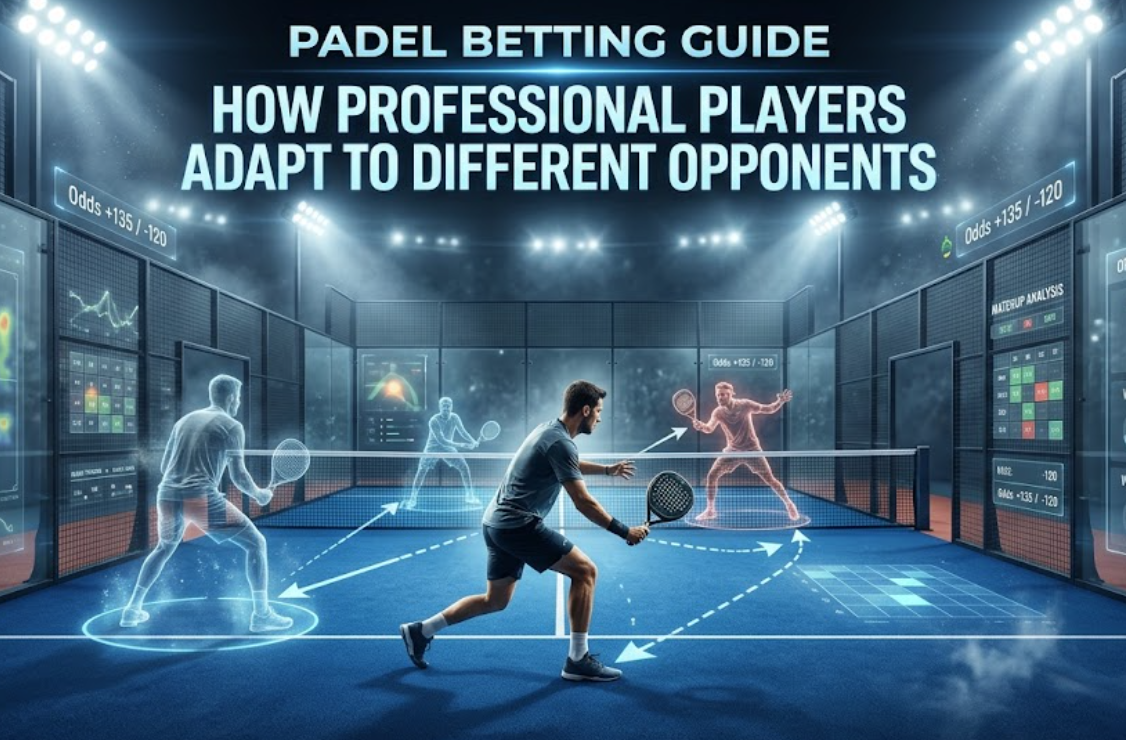
Professional padel is not a sport where one strategy works against every opponent. A partnership that dominates through aggressive overheads in one match may need patient defensive construction in the next.
This ability to adapt separates tactical flexibility from simple technical talent. Players must recognize opponent strengths, identify vulnerable spaces, and adjust their approach without losing coordination.
For readers exploring padel betting, understanding adaptability provides valuable context when evaluating unfamiliar matchups and changing competitive conditions.
🎯 What Is Tactical Adaptability?
Tactical adaptability refers to a partnership's ability to modify its decisions in response to opponents, court conditions, and match developments.
These modifications may involve shot selection, positioning, attacking direction, or the balance between aggression and defensive consistency.
Successful adaptation does not require abandoning an established playing identity. Instead, players adjust specific elements while preserving their fundamental strengths.
Common Tactical Adjustments
| Opponent Strength | Possible Adjustment | Objective |
|---|---|---|
| Powerful Overheads | Deeper lobs | Reduce comfortable attacks |
| Strong Net Coverage | Low returns | Disrupt first volleys |
| Defensive Consistency | More patient placement | Create open spaces |
| Predictable Positioning | Vary shot direction | Force movement adjustments |
⚔️ Recognizing Opponent Weaknesses
Professional partnerships constantly evaluate how opponents respond to different shots. A player may struggle with low volleys, while another might prefer predictable cross-court exchanges.
However, apparent weaknesses should not be diagnosed from isolated mistakes. Reliable observations require repeated evidence across multiple rallies.
Testing Defensive Positioning
Players may vary lob depth and direction to discover whether opponents recover comfortably. Repeated successful defensive responses suggest that a different approach may be necessary.
Changing Attacking Direction
A partnership might direct more shots toward one opponent or target the space between players. This can disrupt established movement patterns, although predictable targeting may become easier to defend.
Adjusting Rally Tempo
Some opponents prefer rapid exchanges, while others are comfortable constructing longer rallies. Changing pace can disrupt timing and create new tactical opportunities.
🎯 Pro Tip: Look for changes in shot placement after a partnership loses several games. Successful adaptation is often visible through improved positioning before it becomes obvious on the scoreboard.
📊 Comparing Adaptable and Rigid Partnerships
Teams with tactical flexibility may possess additional options when their initial strategy fails. However, frequent changes are not automatically beneficial.
| Characteristic | Flexible Partnership | Less Flexible Partnership |
|---|---|---|
| Shot Selection | Varies with conditions | Relies on familiar patterns |
| Defensive Response | Multiple recovery options | Limited adjustments |
| Opponent Targeting | Changes when necessary | May become predictable |
| Coordination | Requires shared decisions | May benefit from familiarity |
These categories are analytical descriptions rather than official player classifications. Actual partnerships may demonstrate different levels of flexibility depending on the opponent.
🏆 Evaluating Adaptability During Competition
One useful approach is to compare the opening games with later stages of the match. Identify whether the partnership changes its tactical choices after encountering repeated difficulties.
For example, a team initially struggling against powerful overheads may begin producing deeper lobs. If opponents subsequently lose net position more frequently, the adjustment may be working.
However, the opposing partnership can respond with different overhead selection or positioning.
Official tournament information from the International Padel Federation and Premier Padel helps establish competitive context.
Adaptability Checklist
- Does the partnership recognize repeated tactical problems?
- Are adjustments coordinated between both players?
- Do changes improve court positioning?
- Can opponents counter the new strategy?
- Are improvements sustained across several games?
💰 Adaptability and Market Expectations
Tactical flexibility can influence competitive performance, but identifying an adaptable partnership does not automatically establish favorable odds.
In padel betting, analysts should consider whether available prices already reflect established competitive strengths.
Imagine a hypothetical partnership losing the opening set before successfully changing its return strategy. That adjustment may improve its prospects, but it cannot guarantee a comeback.
Opponent quality, remaining match length, physical condition, and uncertainty all remain relevant.
⚡ Betting Insight: Tactical adaptation is evidence of problem-solving, not proof of an inevitable reversal. Avoid assigning excessive significance to a few successful rallies.
🔐 Reliable Research and Secure Access
Accurate analysis should rely on verified results and observable tactical adjustments. Avoid unsupported claims about a partnership's ability to recover from particular scores.
Searches involving crypto casino mirror sites may expose users to imitation websites or misleading advertisements.
Before using a trustdice mirror site, independently verify authenticity, security, and regional availability.
Wagering involves financial risk. Establish spending limits and avoid chasing losses.
💡 Final Thoughts
Tactical adaptability is an important characteristic of successful professional padel partnerships. Players must recognize changing conditions, communicate effectively, and modify their approach without sacrificing coordination.
However, flexibility does not guarantee success. Adjustments must be executed effectively, and opponents can respond with strategies of their own.
By studying these interactions alongside verified tournament information, spectators can develop a deeper understanding of professional padel and its evolving tactical challenges.