







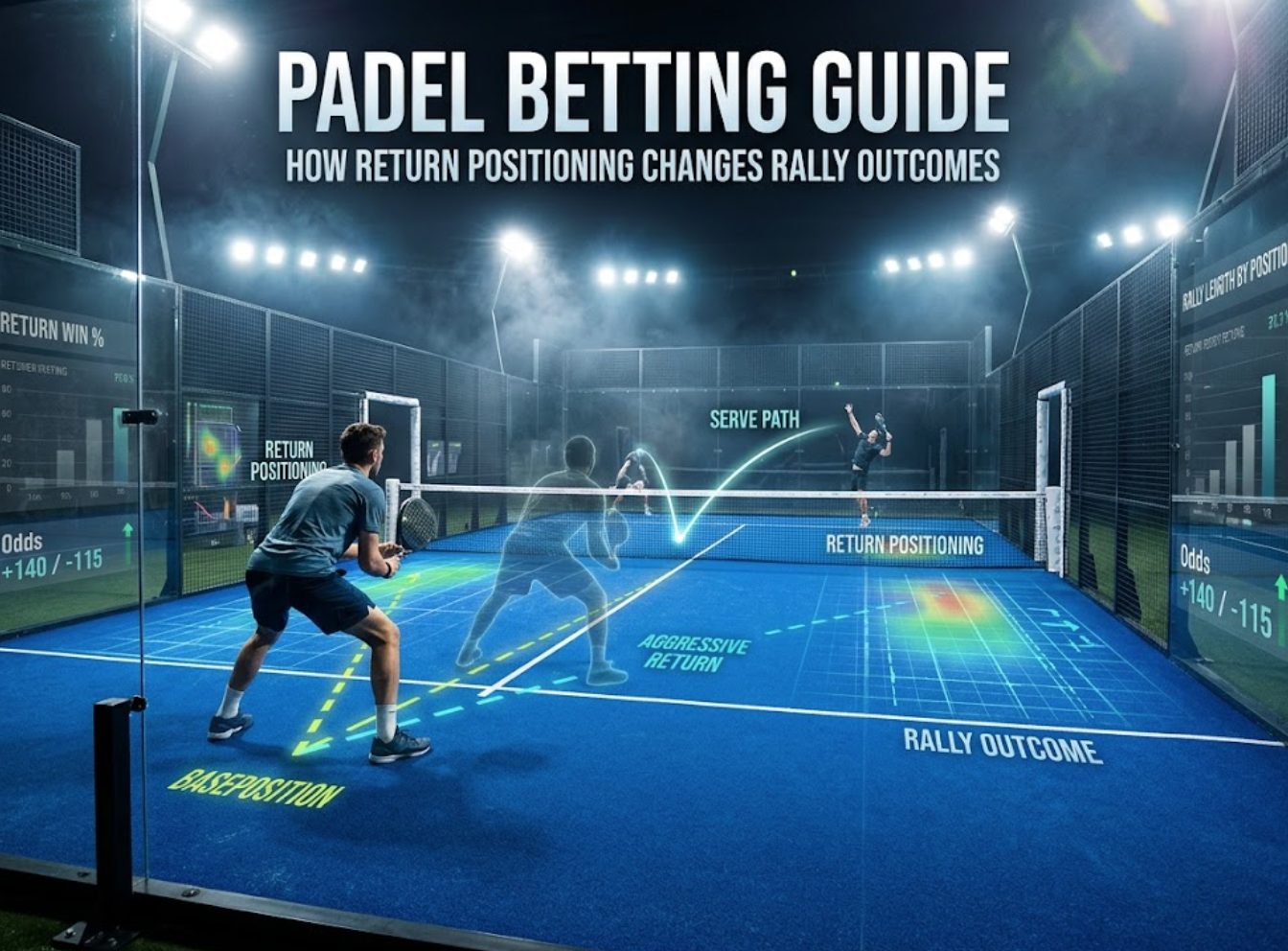
The return of serve is one of the most underestimated elements of professional padel. A well-placed return can immediately disrupt an opponent's attempt to establish net control, while a poorly executed return may create an easy attacking opportunity.
Unlike tennis, where powerful serves frequently dominate exchanges, padel uses an underarm serving motion. This makes positioning, anticipation, and return placement particularly important.
For spectators researching padel betting, understanding return positioning provides a practical way to evaluate how partnerships challenge their opponents' service games.
🎾 Why Return Positioning Matters
Before receiving serve, players must consider the server's likely placement, the potential rebound from the glass, and their own ability to move forward after returning.
Standing too close to the service line may make deeper serves difficult to handle. Positioning excessively far back can provide the serving partnership additional time to establish the net.
The appropriate receiving position therefore depends on individual technique, serve characteristics, and tactical preferences.
Common Receiving Positions
| Position | Potential Benefit | Potential Problem |
|---|---|---|
| Closer to Service Line | Earlier interception | Less reaction time |
| Deeper Position | More preparation space | Greater distance to net |
| Adjusted Toward Side Glass | Covers selected serve angles | May expose other directions |
⚔️ Choosing the Right Return
Return positioning influences which shots are available. Players receiving a comfortable serve may attack with a low return, while those defending a difficult trajectory might prioritize keeping the ball in play.
Low Returns
A low return directed toward the advancing server's feet can force an uncomfortable first volley. This may prevent the serving partnership from immediately controlling the rally.
Defensive Lobs
A well-placed lob can push the serving team away from the net. However, short lobs create attacking opportunities for opponents.
Controlled Cross-Court Returns
Cross-court placement can provide useful angles and additional court space, but predictable direction may allow opponents to anticipate the next shot.
🎯 Pro Tip: Observe where the receiver stands before the serve and how that position changes after repeated deliveries. Small adjustments can reveal attempts to counter specific serving patterns.
📊 Comparing Return Strategies
Each return type creates different tactical possibilities. Successful partnerships vary their choices according to the incoming serve and opponents' positions.
| Return | Main Objective | Execution Risk |
|---|---|---|
| Low Return | Challenge first volley | Net errors |
| Deep Lob | Disrupt net approach | Short placement |
| Cross-Court Drive | Create difficult angles | Predictable direction |
| Controlled Block | Maintain rally consistency | Easy opponent volley |
The effectiveness of each option depends on execution and the serving partnership's ability to respond.
🏆 How Return Positioning Influences Break Opportunities
Receiving partnerships create break opportunities when they repeatedly challenge the serving team's preferred attacking sequence.
A successful return does not necessarily win the point immediately. Its value may come from forcing an awkward volley that creates a favorable next shot.
Consider a hypothetical match where Team A repeatedly serves toward the side glass. Team B initially struggles, but later adjusts its receiving position and begins returning more consistently.
This change may reduce Team A's attacking advantage, although the serving partnership can respond by varying placement.
The International Padel Federation publishes official service regulations, while Premier Padel provides tournament information and results.
Practical Observation Checklist
- Does the receiver adjust position against different serves?
- Are low returns forcing difficult first volleys?
- Can the receiving pair recover net position?
- Does the server successfully vary placement?
- Are return improvements sustained across several games?
💰 Return Performance and Market Expectations
Return quality can provide useful evidence about competitive balance, particularly when a partnership consistently creates pressure during opponents' service games.
For padel betting, these observations should complement verified results rather than replace broader analysis.
For example, hypothetical decimal odds of 2.20 imply a break-even probability of approximately 45.5%. That calculation does not establish the true probability of an outcome.
A reliable assessment requires considering opponent quality, tactical adjustments, match conditions, and uncertainty.
⚡ Betting Insight: Improved returning does not guarantee a service break. Distinguish repeated tactical pressure from isolated successful returns, and avoid reacting impulsively to short scoring sequences.
🔐 Reliable Research and Platform Security
Match analysis should rely on verified competition information and observable tactical patterns rather than unsupported return statistics.
Searches involving crypto casino mirror sites may expose users to imitation websites or misleading advertisements.
Before accessing a trustdice mirror site, independently verify authenticity, security, and regional availability.
Wagering involves financial risk. Establish spending limits and avoid chasing losses.
💡 Final Thoughts
Return positioning plays a major role in professional padel because it influences the opening exchanges of service games. Small adjustments in court position can change the quality of returns and disrupt opponents' attempts to control the net.
However, successful analysis requires evaluating entire tactical sequences rather than individual returns.
By combining direct observation with official tournament information, spectators can better understand how receiving partnerships create pressure and influence match development.