







A padel court may look like a smaller tennis court surrounded by glass, but almost every part of its design affects how the sport is played. The dimensions determine how quickly players can reach the net, while the walls create rebounds that would be impossible on an open court.
For beginners, understanding the court is one of the fastest ways to understand padel itself. This guide explains standard padel court dimensions, service lines, walls, net positioning, and how different areas influence tactics in 2026.
What Is the Standard Padel Court Size?
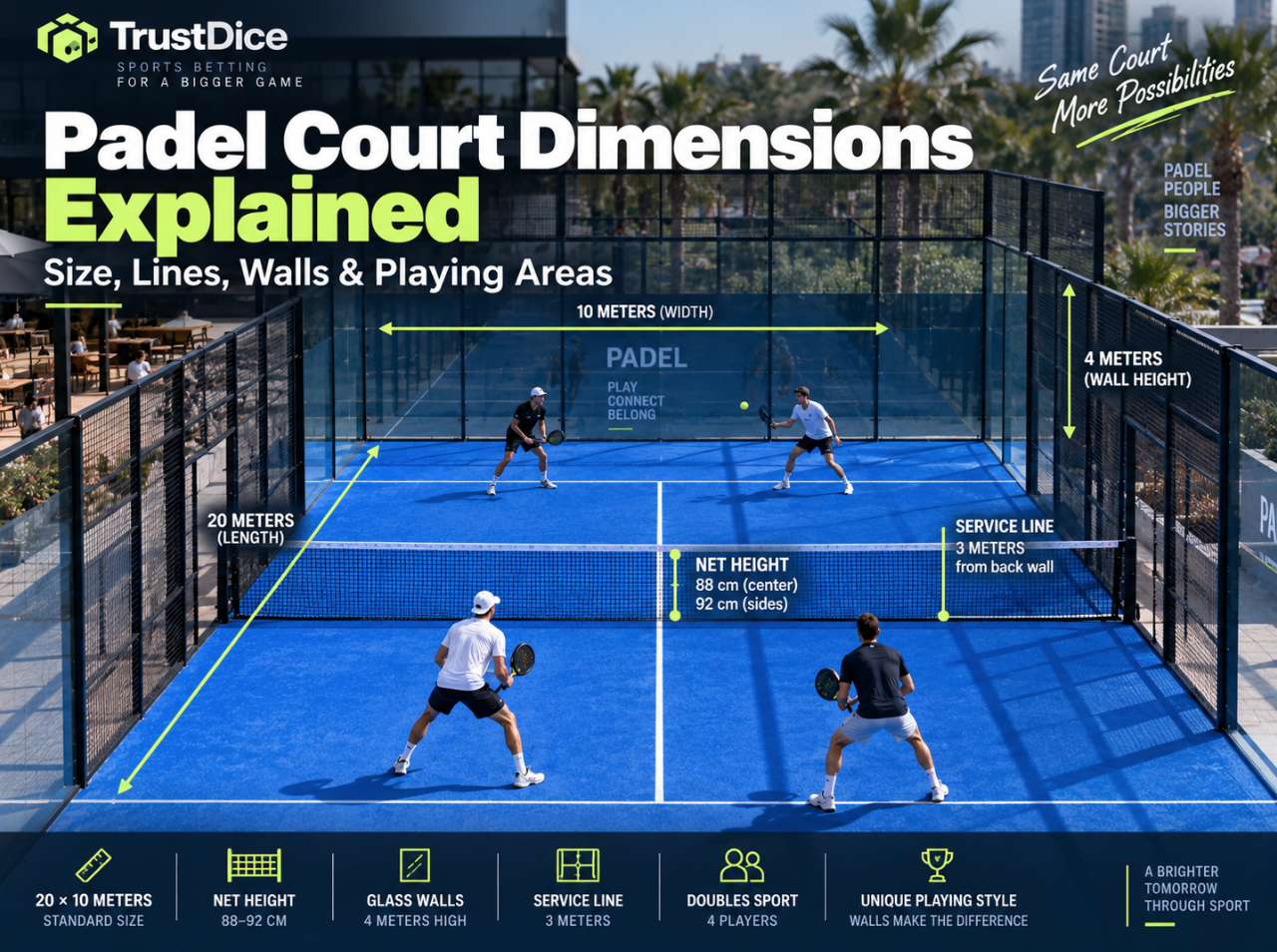
A standard padel court measures 20 meters long and 10 meters wide. The net divides the court into two equal halves, each measuring approximately 10 × 10 meters.
Padel is primarily designed for doubles, so four players share this relatively compact playing area. That smaller footprint creates quick exchanges, but the enclosure means players must also account for rebounds from behind and beside them.
| Court Feature | Standard Measurement / Role |
|---|---|
| Length | 20 meters |
| Width | 10 meters |
| Court Halves | Approximately 10 × 10 meters each |
| Net | Runs across the center |
| Service Line | 3 meters from the back wall |
Quick Fact 🎯
A padel court is not simply a reduced tennis court. Its enclosed architecture is an active part of the sport and directly influences defensive and attacking tactics.
How Is a Padel Court Divided?
The net separates the two teams, while service lines divide the rear portion of each side into service areas. A central line separates the service boxes.
The serve must travel diagonally into the correct service box. Unlike tennis, padel uses an underarm serve after bouncing the ball.
Once the rally begins, players are not restricted to those service boxes. The entire legal playing area becomes available, and positioning becomes much more fluid.
Why Does a Padel Court Have Glass Walls?
The glass enclosure is one of padel's defining features. After an opponent's shot legally bounces on your side, it can rebound from an appropriate wall and remain playable.
This completely changes defensive movement.
Beginners often stand too close to the back glass because they are afraid of letting the ball pass them. Experienced players frequently create more space, allowing the rebound to bring the ball back into a comfortable hitting position.
⚔️ Player Tip: When defending near the back of the court, do not automatically chase every deep ball. Learn its trajectory and give yourself enough room to use the glass.
How High Are the Padel Court Walls?
The enclosure combines glass or solid wall sections with metallic mesh according to official court specifications. The rear wall is generally 4 meters high overall, with the lower section commonly formed by glass or another permitted solid material and the upper area completed with mesh.
Side enclosure configurations can vary within official specifications, which is why professional courts may not appear completely identical when viewed from different venues.
For players, the important concept is that the enclosure is not decorative. Its dimensions determine rebound angles and influence how much time a defender has to react.
How High Is a Padel Net?
The net runs across the middle of the court and is slightly lower at its center than at the sides. Under standard specifications, it measures approximately 88 centimeters at the center and rises to about 92 centimeters at the ends.
That small difference may sound insignificant, but net height matters during low volleys and controlled attacking shots.
| Court Area | Tactical Purpose |
|---|---|
| Net Area | Attacking volleys and pressure |
| Mid-Court | Transition between attack and defense |
| Back Court | Defense and wall rebounds |
| Corners | Complex rebounds and defensive decisions |
Why Net Position Is So Valuable
Although every part of the court matters, experienced pairs generally want opportunities to control the net.
From an attacking position, players can intercept the ball with volleys and reduce their opponents' reaction time. The defending pair often responds with a lob, attempting to force the attackers backward.
This creates the central territorial battle in padel: one pair controls the net while the other searches for an opportunity to take it away.
Tactical Insight 🏆
Watch where the players stand rather than only where the ball travels. Court position often reveals which team is controlling the rally before the scoreboard changes.
Why the Corners Are Difficult for Beginners
The back corners introduce another layer of complexity because the ball can interact with multiple surfaces. Reading the resulting trajectory requires experience.
Beginners commonly move toward the ball too early and become trapped against the enclosure. Better defenders create space and wait long enough to understand the rebound.
Practicing corner defense is therefore one of the most valuable exercises for players who already understand basic groundstrokes.
Do Court Conditions Affect Professional Matches?
Yes. Court dimensions are standardized, but match conditions are not always identical. Indoor versus outdoor environments, temperature, humidity, altitude, surface characteristics, and ball behavior can influence rally speed.
Faster conditions may make aggressive overhead play more effective, while slower conditions can encourage longer defensive exchanges.
These factors provide useful context for fans researching padel betting. Previous results, rankings, and head-to-head records should be considered alongside current conditions rather than interpreted in isolation.
Understanding Court Geometry Makes Padel Easier to Watch
Once you understand the dimensions, professional matches become easier to read. A lob is no longer simply a high defensive shot—it can be an attempt to force opponents away from the net.
A player waiting for a back-glass rebound is not necessarily reacting slowly. They may deliberately be using the architecture to create a better defensive shot.
This is what makes padel court geometry so important: the walls, corners, net, and available space continuously influence tactical decisions.
Accessing Padel Content Online Safely
Fans following professional matches online should verify the domains they use, particularly when accessing gaming services through alternative addresses.
Users looking for crypto casino mirror sites should confirm the destination rather than trusting unknown links shared through messages or unofficial accounts.
The same precaution applies when searching for a trustdice mirror site: verify the address before entering account information.
Final Thoughts
A standard padel court measures 20 × 10 meters, but those numbers explain only part of the game. The net, service boxes, glass walls, mesh enclosure, corners, and compact dimensions combine to create padel's distinctive tactical environment.
For beginners, learning the court means learning when to move forward, when to retreat, and when to let the glass do some of the defensive work.
Once you understand that geometry, padel becomes much easier to play—and considerably more interesting to watch.