







Watching padel is easy. Reading a padel match is much harder. Two pairs can exchange spectacular shots for several minutes, yet the real tactical battle may be happening somewhere less obvious: who controls the net, which player is being targeted, and how effectively each partnership moves together.
For beginners, learning these patterns transforms the viewing experience. Instead of focusing only on winners and smashes, you begin to understand why certain shots create pressure and why a pair can look uncomfortable even while the score remains close.
This guide explains how to analyze a professional padel match in 2026 using form, partnerships, positioning, tactical matchups, and playing conditions.
Start With Recent Form, Not Reputation
Player reputation provides useful background, but current form gives more immediate context. Look at several recent tournaments rather than only the previous match.
A pair consistently reaching semifinals against elite opposition may be performing well even without winning a title. Conversely, several victories against lower-ranked opposition may make a record look stronger than the underlying performances suggest.
| Factor | What to Check |
|---|---|
| Recent Results | Last several tournaments, not one match |
| Opponent Quality | Strength of pairs faced |
| Tournament Depth | Frequency of quarterfinal, semifinal, or final appearances |
| Partnership Changes | Whether results came with the current partner |
Analysis Tip 🎯
Never treat a win-loss record without context. Who a pair played, where they played, and which partner they played with can significantly change what those results tell you.
Pair Chemistry Is Critical
Padel is fundamentally a doubles sport, so evaluating two players independently can create a misleading picture.
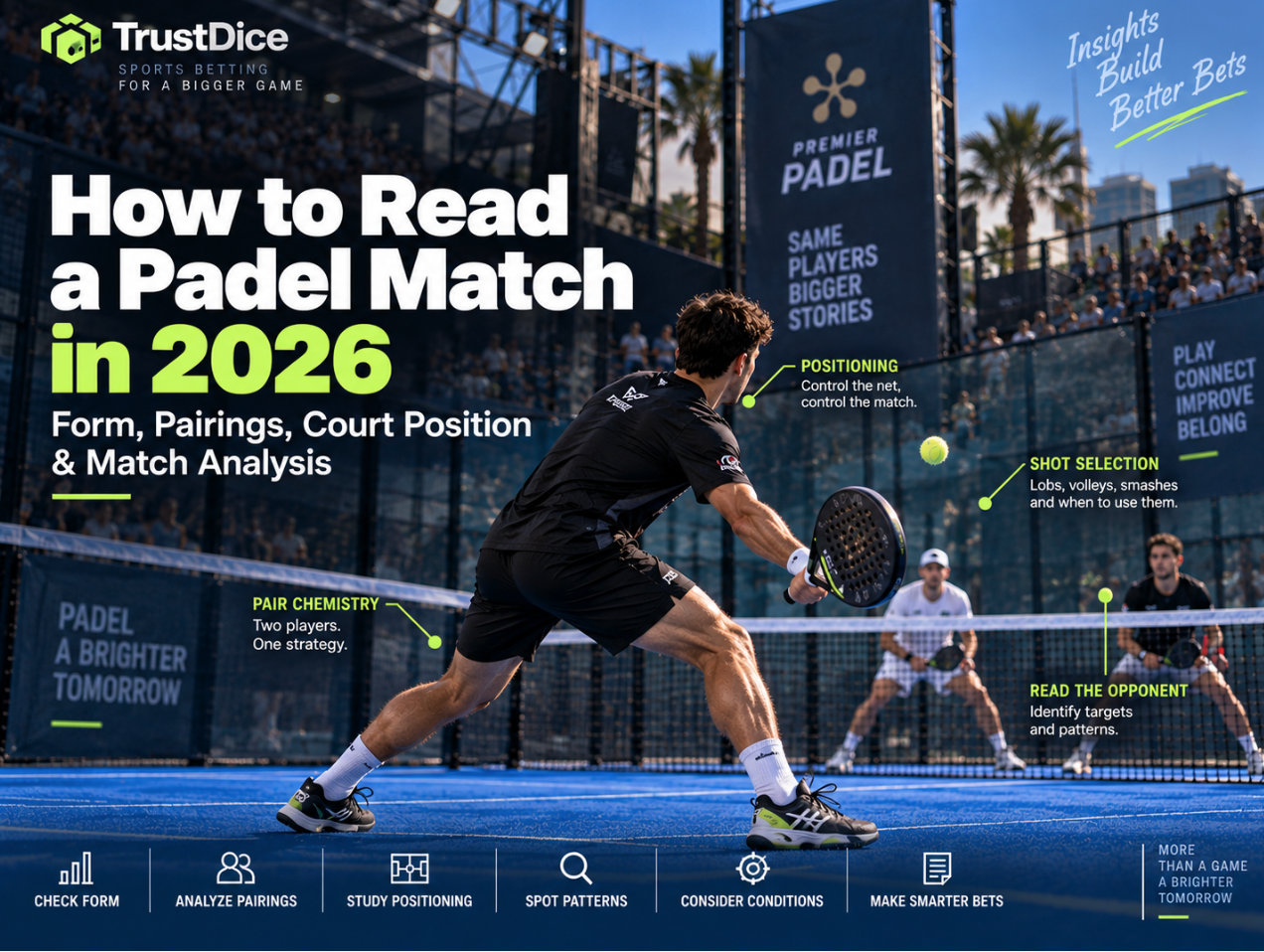
Strong partnerships understand how to divide the court. They know who should cover the middle, when both players should advance, and how to reorganize when opponents force them away from the net.
New partnerships may need time to develop these patterns. Even two highly skilled players can initially leave gaps if their movement and communication are not synchronized.
When analyzing live professional matches, watch what happens immediately after one partner moves. Does the other player adjust automatically? If not, opponents may repeatedly target the resulting space.
Watch Who Controls the Net
Net position is one of the most important tactical indicators in padel. The pair closer to the net can volley earlier, reduce opponents' reaction time, and create sharper angles.
This does not mean the team at the net automatically wins the rally. Defenders can use lobs to push attackers backward and reclaim the attacking position.
That creates a useful pattern for spectators to follow:
| Situation | What It Suggests |
|---|---|
| Pair consistently controls net | Sustained attacking pressure |
| Opponents repeatedly use lobs | Attempt to regain position |
| Pair trapped near back glass | Extended defensive phase |
| Frequent positional exchanges | More balanced tactical contest |
⚔️ Viewing Trick: For one complete rally, stop watching the ball. Watch the four players' feet instead. You will immediately see which pair is controlling territory.
Identify Which Player Is Being Targeted
Professional pairs do not always distribute shots evenly. If one opponent is uncomfortable under pressure, defending a particular side, or struggling with overheads, the other pair may deliberately direct more balls toward that player.
This can become particularly noticeable during important points.
Watch whether one player receives repeated serves, defensive balls, or lobs. Also observe whether the targeted player starts changing position or taking lower-percentage shots.
In our match analysis, this is often more revealing than counting spectacular winners. Tactical pressure can accumulate for several games before it becomes obvious on the scoreboard.
Understand the Importance of the Lob
The lob is one of the most important shots for reading padel correctly. Beginners sometimes interpret it as purely defensive, but its strategic purpose is often positional.
A deep lob can force opponents away from the net, giving the defending pair time to advance. If the attacking player produces a weak overhead, the entire structure of the rally can reverse.
Watch how effectively each pair handles lobs. Strong overhead players can maintain net control even when pushed backward, while weaker overhead responses may repeatedly surrender the attacking position.
Look Beyond the Scoreboard
A 4-4 set can look perfectly balanced, but the underlying rallies may tell another story.
One pair might consistently create break opportunities while the other survives through narrow margins. Alternatively, a team may lead despite producing more unforced errors because a few decisive points have gone their way.
Match Insight 📊
The score tells you what has happened. Rally patterns can help explain how it happened. Use both rather than treating either one as the complete picture.
Playing Conditions Matter
Not every padel court produces identical match dynamics. Indoor or outdoor conditions, temperature, altitude, humidity, and ball behavior can influence rally speed.
Faster conditions can make aggressive overheads more dangerous. Slower conditions may create longer exchanges and increase the importance of patient defense.
This is particularly relevant when comparing previous meetings. A head-to-head result from different conditions may not provide a perfect template for the next match.
Using Match Analysis for Padel Markets
These tactical principles also provide context for anyone researching padel betting. Rankings and odds are useful starting points, but neither explains exactly how two pairs interact tactically.
Consider recent form, current partnerships, opponent quality, net control, head-to-head context, tournament workload, and playing conditions together. A single statistic rarely captures the complete matchup.
Live markets require particular caution. One break of serve or short run of points can move prices quickly without necessarily proving that the underlying tactical balance has permanently changed.
Build a Simple Match Analysis Checklist
- Check each pair's recent tournament results.
- Confirm whether the partnership is established or new.
- Compare relevant previous meetings.
- Watch which pair controls the net more consistently.
- Identify whether one player is being targeted.
- Evaluate how effectively each pair handles lobs.
- Consider indoor, outdoor, and court conditions.
- Separate short-term score changes from broader tactical patterns.
This approach will not predict every result. Its purpose is to build a more complete interpretation of what is happening on court.
Follow Padel Online Safely
Fans increasingly use online platforms for schedules, statistics, streams, and sports markets. Always verify the domain before entering account credentials or financial information.
Users researching crypto casino mirror sites should avoid opening unfamiliar addresses distributed through unsolicited messages or unofficial social accounts.
Likewise, anyone searching for a trustdice mirror site should confirm the destination before logging in.
Final Thoughts
Reading a padel match becomes easier once you stop following only the ball. Watch the partnerships, court position, net control, lobs, defensive patterns, and tactical targets developing around it.
Recent form provides context, but pair chemistry and matchup dynamics explain much of what happens during the rally itself.
Once you begin recognizing those patterns, professional padel looks completely different. What initially appears to be a sequence of volleys and smashes becomes a continuous battle for space, position, and control.