







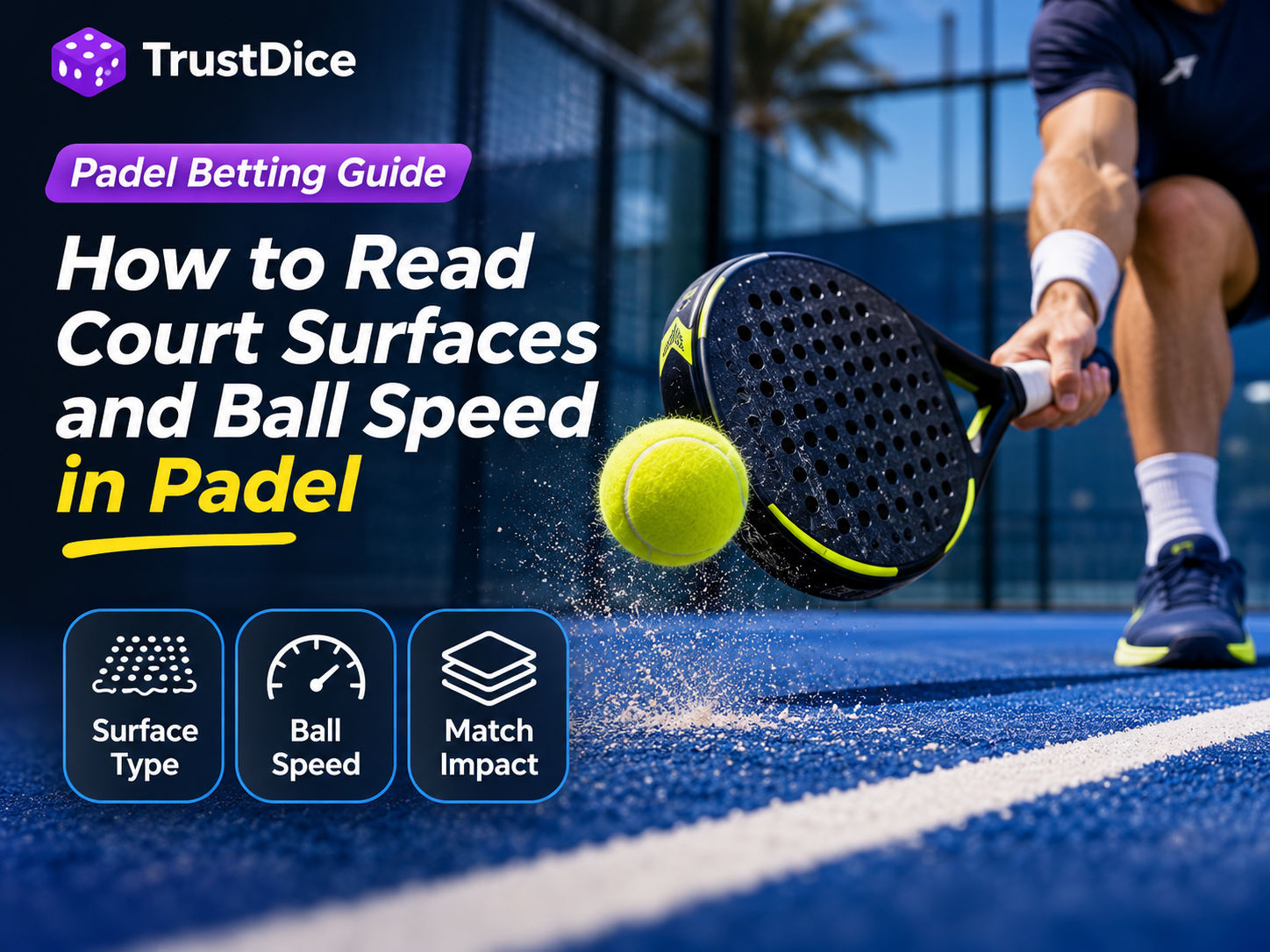
Watch professional padel at two different venues and you may notice something surprising: the same attacking shot can produce completely different defensive responses. A powerful overhead that finishes a rally at one tournament might be returned comfortably at another.
Ball speed, surface characteristics, and rebound behavior help explain these differences. Understanding them makes professional matches easier to interpret and provides useful context for padel betting research.
Rather than assuming that every blue padel court plays identically, informed spectators examine how the surface interacts with the ball, players' movement, and tactical decisions.
🎾 Understanding Modern Padel Court Surfaces
Professional padel courts commonly feature synthetic turf installed over a prepared base. The playing surface must provide suitable traction, predictable ball behavior, and safe movement conditions.
Although courts may look similar on television, differences in turf construction, infill distribution, maintenance, and wear can affect how they perform.
The International Padel Federation publishes official court requirements and technical regulations. These standards help establish acceptable playing conditions without implying that every venue produces identical rallies.
Surface Characteristics Worth Observing
| Characteristic | Potential Influence | What to Observe |
|---|---|---|
| Turf Texture | Traction and ball interaction | Movement stability |
| Infill Distribution | Surface consistency | Unusual or inconsistent bounces |
| Surface Wear | Local differences in playing behavior | Repeated movement adjustments |
| Moisture | Traction and ball behavior | Footing and defensive recovery |
These variables should be treated as possible influences, not automatic predictions. Direct observation is necessary before concluding that a court favors a particular style.
⚡ How Ball Speed Changes Tactical Opportunities
Ball speed is influenced by more than the surface. Ball construction, internal pressure, temperature, aerodynamic resistance, and shot execution all contribute to how quickly a rally develops.
When balls travel and rebound energetically, attacking players may find it easier to produce difficult overheads. When shots are easier to retrieve, defensive partnerships may have more opportunities to extend rallies.
Fast Exchanges and Attacking Play
In lively conditions, an aggressive partnership may use powerful smashes and penetrating volleys to limit defensive recovery time.
However, additional speed can also reduce control. Players attempting difficult winners may make more errors if their positioning is inadequate.
Slower Exchanges and Defensive Construction
When opponents can retrieve more overheads, attacking teams may need to construct points patiently. Controlled volleys, accurate placement, and coordinated movement become particularly valuable.
A defensive partnership might use deep lobs to recover the net rather than attempting risky winners from the back court.
🎯 Pro Tip: Evaluate the result of an overhead rather than its apparent power. A controlled shot that preserves net position may offer greater tactical value than a spectacular smash that opponents retrieve comfortably.
📊 Comparing Faster and Slower Playing Conditions
Playing conditions can influence which tactical choices appear attractive, but they do not establish a universal advantage for aggressive or defensive players.
| Tactical Element | Faster Conditions | Slower Conditions |
|---|---|---|
| Overhead Attacks | May become more decisive | May require greater precision |
| Defensive Recovery | Potentially less reaction time | Potentially more recovery opportunities |
| Lob Selection | Depth control becomes critical | Can support patient construction |
| Net Exchanges | Quick reactions matter | Placement and patience matter |
These are illustrative tendencies. Actual performance depends on the interaction between the environment, opponents, and technical execution.
🏆 Reading Surface Adaptation During Professional Matches
Experienced players often adjust their shot selection after recognizing how the ball behaves at a particular venue.
A partnership initially struggling with overhead depth may reduce power and emphasize placement. Another might change its defensive positioning to accommodate unusually energetic rebounds.
These adjustments can become visible through repeated rallies rather than isolated highlights.
A Practical Observation Checklist
- Do overheads regularly finish points or invite defensive returns?
- Are players struggling to control the depth of their lobs?
- Does the ball rebound consistently from the playing surface?
- Are defensive recoveries becoming easier as players adapt?
- Do both partnerships change their attacking patterns?
Official tournament schedules and match information from Premier Padel can help establish the context for comparing performances at different venues.
💰 Using Surface Research in Market Analysis
Surface characteristics may influence match expectations, but identifying a potential tactical benefit does not automatically establish a favorable price.
In padel betting, analysts should consider whether available odds already reflect venue characteristics and the competing partnerships' strengths.
Imagine a hypothetical partnership known for aggressive overheads playing under conditions that appear favorable for attacking. That observation may support further research, but it cannot independently justify a precise winning probability.
Opponent quality, defensive technique, partnership coordination, and recent performance remain relevant. A single environmental variable should never dominate the assessment.
⚡ Betting Insight: Market odds represent prices, not guarantees. Even a genuine environmental advantage may already be incorporated into those prices. Avoid overconfidence and never chase losses.
🔐 Research Quality and Secure Platform Access
Reliable analysis begins with official tournament information and observable evidence. Avoid unsupported claims that a particular court always produces a specific number of winners or favors one partnership.
Security also matters when researching gaming platforms. Searches involving crypto casino mirror sites may lead to imitation websites or misleading promotional material.
Before using a trustdice mirror site, independently verify its authenticity, regional availability, and security arrangements.
Wagering involves financial risk. Establish spending limits and treat uncertain environmental assessments as supporting information rather than guaranteed predictions.
💡 Final Thoughts
Padel court surfaces and ball behavior influence how professional partnerships attack, defend, and recover position. Although standardized court requirements establish a common foundation, venue characteristics can create meaningful differences in playing conditions.
The strongest analysis combines technical understanding with direct observation. Instead of assuming that faster conditions always favor attackers, examine whether individual partnerships actually exploit the opportunities available.
By considering surface behavior alongside verified competition information, spectators can develop a more complete understanding of professional padel and the tactical decisions shaping each match.