







Two padel partnerships can possess similar technical ability yet approach the same rally in completely different ways. One pair attacks the net aggressively, while another prefers patient defensive exchanges. Understanding these contrasting approaches helps explain why certain matchups become unexpectedly competitive.
For newcomers interested in padel betting, identifying playing styles provides a practical foundation for interpreting professional matches. Rather than relying exclusively on rankings or recent victories, observers can examine how each partnership constructs points and responds to pressure.
🎾 The Four Main Playing Styles in Padel
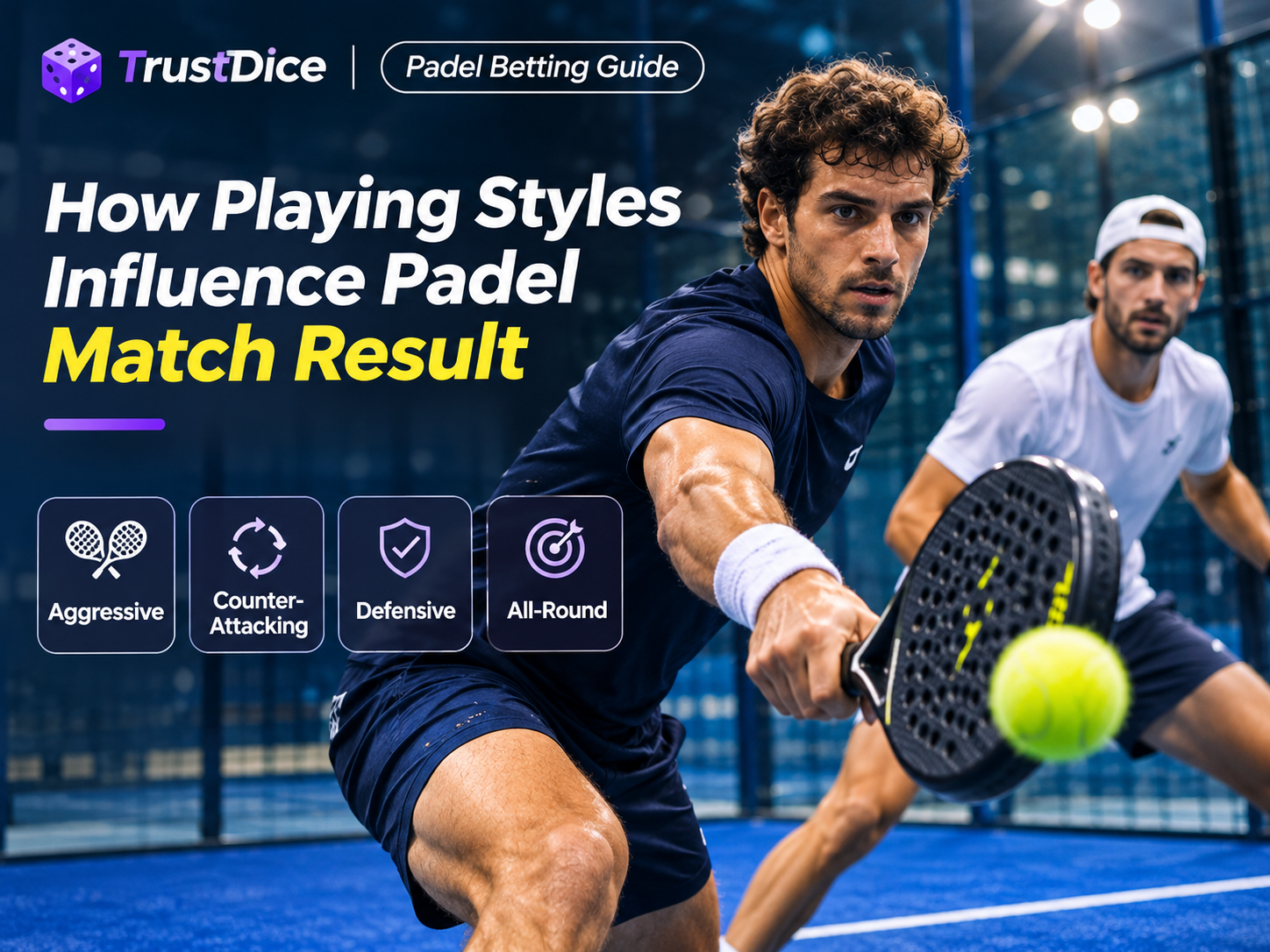
Professional players rarely fit perfectly into one category. Nevertheless, four broad tactical approaches provide a useful framework for beginners.
1. Aggressive Attacking
Aggressive partnerships prioritize net control, powerful overheads, and opportunities to finish points quickly. They attempt to prevent opponents from settling into comfortable defensive positions.
This approach can be effective when attacking players consistently receive manageable balls. However, excessive aggression creates opportunities for errors and counterattacks.
2. Defensive Consistency
Defensive partnerships specialize in retrieving difficult shots, using glass rebounds, and extending rallies. Their objective is often to survive initial pressure before recovering favorable positioning.
Patience is essential, but remaining behind the service line indefinitely can allow opponents to dominate.
3. Counterattacking
Counterattacking teams absorb pressure before exploiting poorly positioned opponents. Accurate lobs and well-timed passing shots help them transform defensive situations into attacking opportunities.
4. All-Round Play
Balanced partnerships combine aggressive and defensive techniques. Their greatest strength is the ability to adjust when an initial strategy stops working.
| Playing Style | Primary Strength | Potential Weakness |
|---|---|---|
| Aggressive | Attacking pressure | Unforced errors |
| Defensive | Rally consistency | Difficulty gaining net control |
| Counterattacking | Exploiting poor positioning | Dependence on recovery quality |
| All-Round | Tactical flexibility | Complex coordination |
⚔️ Why Tactical Matchups Matter
Playing styles become particularly interesting when contrasting partnerships compete against each other.
Imagine an aggressive team facing opponents who specialize in retrieving overheads. The attacking partnership might initially control most rallies, but repeated defensive recoveries could force it into increasingly difficult shot selections.
Alternatively, a defensive team may struggle against opponents who consistently place controlled volleys into open spaces rather than attempting spectacular winners.
The important question is not which style is universally superior. It is which partnership can impose its preferred tactical conditions.
🎯 Pro Tip: Watch the first several complete rallies. Identify which partnership controls the net, how opponents respond to lobs, and whether attacking shots consistently create genuine advantages.
📊 Reading Tactical Adjustments During Matches
Professional padel involves continuous adaptation. A partnership that struggles during the opening games may improve after changing its return placement or defensive formation.
For example, opponents repeatedly attacking the same player might encourage that partnership to adjust court coverage. A defensive pair could also begin advancing earlier to prevent aggressive opponents from controlling every exchange.
Common Tactical Adjustments
| Observed Problem | Possible Adjustment | Desired Result |
|---|---|---|
| Repeated overhead pressure | Deeper defensive lobs | Push attackers backward |
| Weak first volleys | Change serve placement | Improve net approach |
| Central court gaps | Coordinate positioning | Reduce exposed space |
| Excessive attacking errors | Use controlled overheads | Maintain rally pressure |
These adjustments should be evaluated across multiple rallies. One successful point does not establish that a tactical change will remain effective.
🏆 How to Research Professional Playing Styles
Official tournament information helps establish the competitive context behind tactical observations. The International Padel Federation provides rankings and competition resources, while Premier Padel publishes tournament information and results.
Match footage can then reveal details that basic scorelines cannot explain. Look for repeated patterns rather than isolated highlights.
Practical Research Checklist
- Identify each partnership's preferred attacking positions.
- Observe how effectively players defend deep overheads.
- Compare tactical performance against different opponents.
- Evaluate communication during defensive transitions.
- Check whether playing conditions influence shot effectiveness.
When analyzing padel betting markets, these observations can complement verified results and probability estimates. They should not be treated as guarantees.
💰 Understanding Tactical Advantages and Market Prices
A favorable tactical matchup does not automatically represent a favorable wagering opportunity. Market prices may already reflect widely recognized strengths and weaknesses.
Consider hypothetical decimal odds of 1.80. These correspond to a break-even probability of approximately 55.6%, calculated by dividing one by the odds.
That figure does not reveal the true probability of winning. Establishing a credible estimate requires broader evidence, including opponent quality, recent performance, and uncertainty surrounding tactical assumptions.
⚡ Betting Insight: Never confuse tactical superiority with certainty. Even a partnership controlling most rallies can lose important points. Avoid chasing losses or increasing stakes because of short-term momentum.
🔐 Research Security and Responsible Access
Research should rely on official sources and independently verified information. Online platform security deserves similar attention.
Searches involving crypto casino mirror sites may expose users to imitation websites or misleading promotional pages.
Before accessing a trustdice mirror site, independently verify its authenticity, regional availability, and security arrangements.
Set clear spending limits and remember that no tactical framework eliminates the financial risks associated with wagering.
💡 Final Thoughts
Playing styles offer a valuable framework for understanding professional padel. Aggressive teams seek immediate pressure, defensive partnerships emphasize consistency, counterattackers exploit positioning mistakes, and balanced teams adapt between approaches.
Yet successful analysis requires more than labeling competitors. The most revealing information comes from observing how partnerships interact, adjust their tactics, and respond to changing match conditions.
By combining direct observation with verified tournament information, spectators can develop a deeper understanding of professional padel while maintaining realistic expectations about competitive uncertainty.