







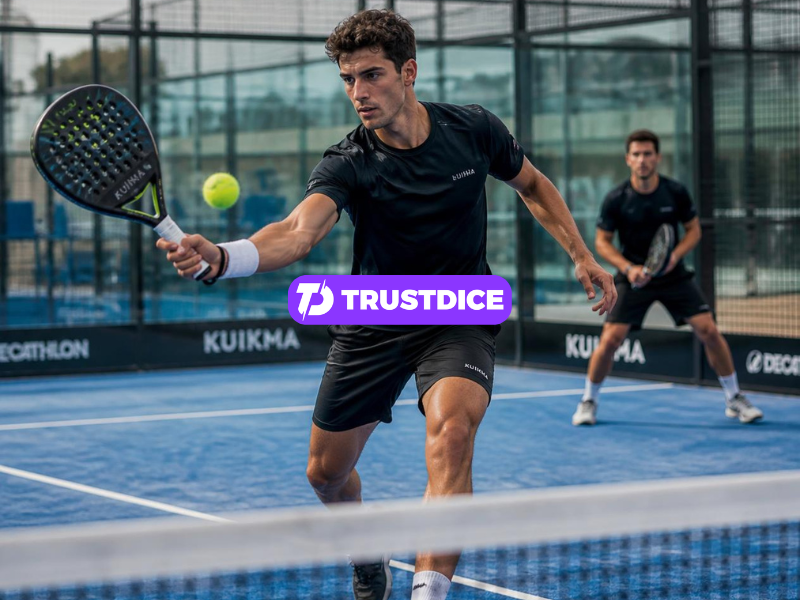
Four players share a relatively small padel court, yet communication problems still create enormous gaps. Two partners can possess excellent individual technique and lose repeatedly because they hesitate over middle balls, move in opposite directions, or fail to tell each other what opponents are doing.
Great padel partnerships communicate before, during, and after rallies. Fortunately, you do not need complicated tactical vocabulary to improve.
Why Communication Matters So Much
Padel players regularly turn toward the back glass, temporarily losing sight of their opponents. Your partner can see information that you cannot.
A simple call can tell you whether opponents are advancing, staying back, or changing positions.
| Call | Purpose |
|---|---|
| Mine | Claim the ball |
| Yours | Partner should play it |
| Back | Opponents have retreated |
| Up | Opponent is approaching |
Team Tip 🎯
Agree on your calls before the match. The exact vocabulary matters less than both players understanding it instantly.
Who Takes the Middle Ball?
There is no rule saying one partner automatically owns every ball through the center.
Forehand position, incoming angle, court location, and who can make stronger contact all matter. Partners should establish preferences while remaining flexible.
Silence is the worst solution. Two players swinging simultaneously is dangerous; two players leaving the same ball untouched is frustrating.
Communicate During Glass Defense
Imagine your partner is facing the back glass while preparing for a rebound. They cannot comfortably watch both the ball and the opponents.
You can provide information. If both opponents have rushed toward the net, your partner may choose a lob. If they remain deep, another return could be appropriate.
🏆 Partnership Insight: Good communication gives your partner information, not instructions delivered after it is already too late.
Move as a Pair
Communication is not exclusively verbal. Positioning communicates too.
When one player advances, the partner should recognize whether the pair has an opportunity to take the net together. When one retreats to defend a lob, the other must react accordingly.
The objective is to prevent large diagonal gaps.
Talk Between Points
Some of the most useful conversations happen when the ball is not moving.
Discuss where opponents are vulnerable. Is one player struggling against deep lobs? Is a particular serve creating weak returns? Are you leaving too much space through the middle?
| Bad Communication | Better Communication |
|---|---|
| “Stop missing.” | “Let's play safer through the middle.” |
| “That was yours.” | “I'll call the next middle ball earlier.” |
| Blame | Specific adjustment |
Avoid Coaching Your Partner Mid-Rally
There is a difference between providing information and overwhelming someone with instructions.
Short, actionable calls work. A five-second technical explanation while your partner is preparing to hit does not.
Save complicated discussions for between games or after the match.
How Elite Partnerships Communicate
Professional players communicate constantly, but much of their coordination is subtle because positioning patterns have been practiced extensively.
Fans watching through a bitcoin sportsbook can learn by observing the player who is not hitting. Watch how they adjust position, signal information, and prepare to cover the next ball.
Stay Constructive Under Pressure
Your partner will miss easy shots. So will you.
Negative body language can damage a partnership surprisingly quickly. Instead of reacting dramatically, reset and discuss tactical patterns when necessary.
This psychological component can also matter for people following bitcoin betting. A pair that begins arguing or displaying visible frustration may struggle to maintain coordinated decision-making.
Mental Tip ⚔️
After an error, communicate about the next point rather than conducting an investigation into the previous one.
Build Simple Patterns
Partnerships improve when both players understand what is likely to happen next. For example, if your partner plays a strong lob, both of you know to look for an opportunity to advance.
If you serve toward the side glass, your partner can anticipate the likely return direction.
Repeated patterns reduce hesitation because decisions become shared rather than improvised.
Final Thoughts
Communication in padel does not require shouting continuously. It requires useful information at the right moment.
Call middle balls early, tell your partner what opponents are doing when their vision is limited, and discuss tactical adjustments between points. Most importantly, keep communication constructive when the match becomes difficult.
Viewers following professional competition on a bitcoin sportsbook should watch partnership behavior alongside individual technique.
Two players who communicate effectively begin moving like one tactical unit—and that is when doubles padel becomes significantly harder to break down. 🤝