







Padel scoring can sound more complicated than the sport itself. The ball may bounce from glass walls and leave the court through an opening, yet the scoreboard still follows a familiar tennis-style structure: points build games, games build sets, and sets decide the match.
The unusual part is the vocabulary. A team can win three rallies and still be described as leading “40–0.” At 40–40, the score becomes deuce. A set may finish 6–4 or continue into a tie-break at 6–6. Some competitions also replace the traditional advantage system with a Golden Point.
This guide breaks down every layer of padel scoring in plain English, following the scoring methods published in the International Padel Federation Rules of Padel, reviewed for application from January 1, 2026.
Quick answer 🎯
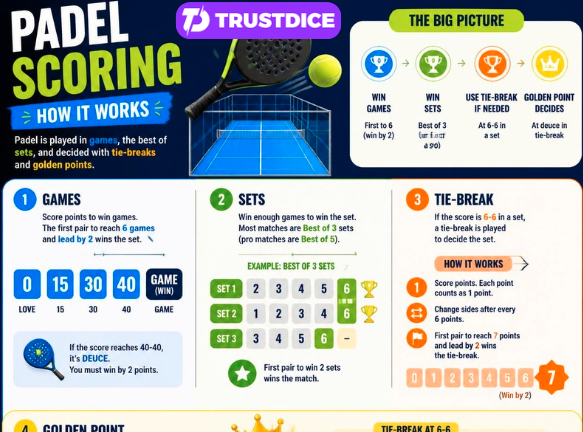
Most padel matches are played as the best of three sets. A team normally wins a set by reaching six games with a two-game lead. If the score reaches 6–6, a tie-break is commonly used to decide the set.
The Three Levels of Padel Scoring
Before learning the individual numbers, it helps to understand the hierarchy. Every successful rally produces one point. Those points determine a game, several games determine a set, and two sets normally determine the match.
| Scoring Level | How It Is Won | Example |
|---|---|---|
| Point | Win one rally | The opponents hit the ball into the net |
| Game | Usually win at least four points with a two-point margin | 15–0, 30–0, 40–0, game |
| Set | Usually win six games with a two-game margin | 6–4 |
| Match | Normally win two sets | 6–4, 3–6, 6–2 |
The score must be called from the serving team’s perspective. If the serving pair has won two points and the receiving pair has won one, the game score is announced as 30–15. This remains true even if the receiver is the player who verbally calls the score.
How Points Are Counted Inside a Game
A standard game begins at 0–0, commonly called “love-all.” The first point won changes a team’s score to 15, the second to 30, and the third to 40. Winning the next rally usually wins the game, provided the opposing pair has not also reached 40.
| Rallies Won by a Team | Score Announced | Meaning |
|---|---|---|
| 0 | Love or 0 | No points won |
| 1 | 15 | First point |
| 2 | 30 | Second point |
| 3 | 40 | One point from the game unless both teams reach 40 |
| 4 or more | Game | The team wins if it holds a two-point margin |
Imagine Pair A wins the opening three rallies. The score progresses from 15–0 to 30–0 and then 40–0. If Pair A wins the fourth rally, it wins the game. If Pair B instead wins the next three rallies, the game reaches 40–40.
The numbers are historical conventions rather than literal point totals. Beginners do not need to understand their origin to keep score correctly. Simply remember the sequence: 0, 15, 30, 40, game.
What Are Deuce and Advantage?
Under traditional scoring, 40–40 is called deuce. From this position, a team must win two consecutive points to take the game.
The first point after deuce produces “advantage” for the team that wins it. If that same team wins the following point, the game ends. If it loses the following point, the score returns to deuce. The cycle can repeat indefinitely until one pair wins two consecutive rallies.
A Deuce Sequence in Practice
Suppose Pair A and Pair B reach 40–40. Pair A wins the next rally, giving it advantage. Pair B then wins, returning the score to deuce. Pair B wins again and gains advantage. If Pair B wins the next rally as well, it finally wins the game.
| Rally Result | New Score | What Happens Next |
|---|---|---|
| Both pairs have won three points | Deuce | A pair needs two consecutive points |
| Pair A wins | Advantage Pair A | Pair A is one point from the game |
| Pair B wins | Deuce | The advantage disappears |
| Pair B wins | Advantage Pair B | Pair B is one point from the game |
| Pair B wins again | Game Pair B | The next game begins at 0–0 |
Beginner shortcut ⚡
At deuce, forget the 15–30–40 sequence. Think of it as a race to win two rallies in a row.
What Is the Golden Point in Padel?
The Golden Point is an alternative to advantage scoring. When a game reaches deuce, the next rally decides the entire game. There is no advantage and no return to deuce.
Under the FIP alternative scoring method, the receiving pair chooses whether the deciding serve will be delivered into the right or left service court. The receiving players cannot exchange their established positions merely to receive that point. In mixed doubles, the receiver must be the same gender as the server.
The team that wins the deciding rally wins the game. This makes the moment easy to understand but tactically intense: one return, volley, lob, or service error can decide a game that might otherwise have continued through several advantages.
Golden Point distinction 🏆
A Golden Point decides a game at deuce. A tie-break decides a set when the game score reaches 6–6. They solve different scoring situations.
Traditional Advantage vs Golden Point
| Feature | Traditional Advantage | Golden Point |
|---|---|---|
| Situation | Used after 40–40 | Used at 40–40 |
| Requirement | Win two consecutive points | Win one deciding point |
| Receiving side | Determined by the normal point sequence | Chosen by the receiving pair |
| Possible duration | No fixed maximum | Exactly one rally after deuce |
Players should confirm the scoring format before warming up. A casual club match, local league, or tournament may use traditional advantage even if another event uses Golden Point. Assuming the wrong format can create an argument at the worst possible moment.
How Do You Win a Set in Padel?
Under the standard format, the first pair to win six games wins the set, but it must lead by at least two games. Scores such as 6–0, 6–2, and 6–4 therefore complete a set.
A 6–5 score does not complete the set because the leading pair has only a one-game advantage. If that pair wins the next game, it takes the set 7–5. If the trailing pair wins, the score becomes 6–6 and a tie-break is normally played.
The requirement for a two-game margin prevents a set from ending 6–5. It also creates a clear late-set tactical phase. At 5–4, the leading pair is serving or returning for the set. At 5–5, both teams know that the next two games will either produce a 7–5 finish or force a tie-break.
How Does a Padel Tie-Break Work?
A standard tie-break uses ordinary numbers—0, 1, 2, 3—instead of 15, 30, and 40. The first pair to reach seven points with a lead of at least two wins the tie-break and the set.
A score of 7–5 completes the tie-break. A score of 7–6 does not, because the margin is only one. Play must continue to 8–6, 9–7, 10–8, or another score that produces a two-point difference.
Serving Order During the Tie-Break
The player whose turn it is to serve delivers the first point from the right side. The service then moves to an opponent, who serves the next two points beginning from the left side. After that, players continue serving two points each in the established order, alternating the service side for every point.
The pairs change ends after every six points. Examples include 4–2, 3–3, and 6–6 because six, twelve, or another multiple of six total points have been played.
The tie-break winner records the set as 7–6. In the following set, a player from the pair that did not begin serving the tie-break starts the opening service game.
Tie-break memory aid 🎾
The opening server serves once. Every server after that takes two points. Change ends after every six total points, and keep playing until one pair leads by two.
How Is a Full Padel Match Won?
A standard match is normally the best of three sets. The first pair to win two sets wins the match. A team can therefore win in straight sets, such as 6–3, 6–4, or recover from losing the opening set to win in three, such as 4–6, 6–2, 6–3.
The third set is often played like the first two, but approved alternative formats may use a match tie-break instead. A match tie-break is commonly played to ten points with a two-point margin and replaces the deciding set.
Short sets are another authorized alternative. In that format, the first pair to four games wins the set with a two-game lead. The applicable tie-break procedure is then used if the score reaches the specified level. These alternatives help leagues and events manage court schedules, but they should always be announced before play.
| Format | Typical Winning Requirement | Where Beginners May See It |
|---|---|---|
| Standard set | Six games with a two-game lead | Regular competitive and recreational matches |
| Tie-break set | Tie-break at 6–6 | Common standard match format |
| Short set | Usually four games with the required margin | Time-limited leagues or event formats |
| Match tie-break | Usually ten points with a two-point lead | Used instead of a final set in selected formats |
When Do Players Change Ends?
Players change ends after the first, third, and every subsequent odd-numbered game of a set. That means they change after 1–0, after the third game, after the fifth game, and so on.
At the end of a set, the pairs change ends unless the total number of games in that set is even. If the set ends after an even number of games, they change after the first game of the next set instead.
During a tie-break, players change ends after every six points. Changing ends matters most outdoors, where sun and wind can make the two halves of the same court feel surprisingly different.
Common Scoring Mistakes
Calling the Receiver’s Score First
The serving pair’s score is always announced first. If the server has won one rally and the receivers have won two, the correct call is 15–30.
Ending a Set at 6–5
A team normally needs a two-game lead. The set continues until 7–5 or enters a tie-break at 6–6.
Treating 7–6 as a Winning Tie-Break Score
A tie-break requires a two-point margin. At 7–6, another point must be played.
Confusing Golden Point with Match Point
Golden Point is a scoring format used at deuce. Match point describes any rally that could win the entire match. A Golden Point can also be a match point, but the terms are not interchangeable.
Forgetting the Serving Rotation
Partners may choose their service order at the beginning of each set, but that order must then be maintained throughout the set. The receiving order is also established and must be respected during the relevant games and tie-break.
How Scoring Changes Match Strategy
The scoreboard should influence shot selection. At 40–0, an attacking pair may accept slightly more risk because it holds several game points. At 30–40, a low-percentage smash can surrender the game immediately. At Golden Point, reliability and a clearly planned service pattern often matter more than surprise for its own sake.
Tie-breaks increase the cost of every loose point. A double fault or rushed return at 2–2 can create a decisive mini-break. Strong pairs simplify their patterns: serve toward a preferred target, protect the middle, use the lob with margin, and avoid trying to manufacture a winner from an unbalanced position.
Scoring knowledge also helps spectators interpret pressure when researching a match through a bitcoin sportsbook. A 6–4 set may have contained several close deuce games, while a 7–6 set could have turned on only two points in the tie-break. The final number does not always reveal how evenly the teams performed.
Anyone considering bitcoin betting should treat scoring patterns as context rather than certainty. Break-point performance and tie-break records can describe previous matches, but they cannot guarantee the next result. Use a fixed entertainment budget and never chase losses through a bitcoin sportsbook.
Scoreboard habit 🧠
Before every return, say the score quietly to yourself. It reduces disputes, clarifies the pressure of the next point, and helps you choose an appropriate level of risk.
Final Thoughts
Padel scoring becomes straightforward once it is separated into layers. Points follow the sequence 0, 15, 30, and 40. Traditional deuce requires two consecutive points, while Golden Point makes the next rally decisive. Six games normally win a set when accompanied by a two-game lead, and a tie-break commonly resolves a 6–6 score.
For a standard best-of-three match, the first pair to win two sets takes the victory. Alternative systems—including short sets, Golden Point, and a deciding match tie-break—may be used, so players should confirm the exact format before the opening serve.
The simplest way to learn is to call the score throughout a practice match. Keep the server’s score first, remember that 6–5 is not normally a completed set, and count tie-break points with ordinary numbers. After a few matches, the scoreboard stops feeling like a separate rulebook and becomes part of the rhythm of the game.