







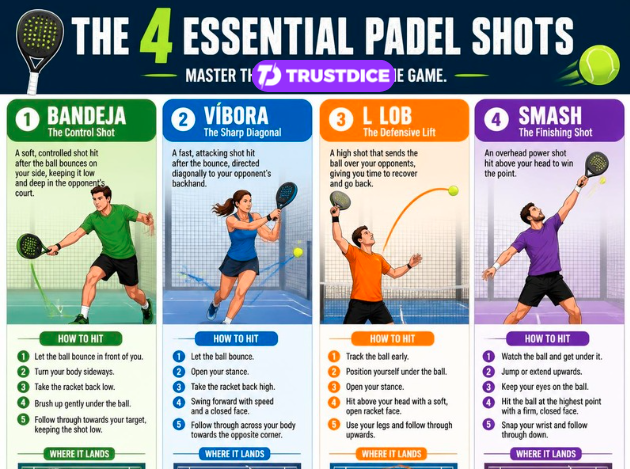
Padel rewards control, positioning, and shot selection more consistently than raw power. A spectacular smash may end the rally, but the quieter shots—a deep lob, a low chiquita, or a controlled bandeja—often create the opportunity.
The key is understanding what each stroke is designed to accomplish. The bandeja protects your net position, the víbora applies greater pressure, the lob moves opponents backward, and the chiquita creates an uncomfortable volley near their feet. Once these purposes are clear, padel stops feeling like improvised tennis inside a glass court.
Shot-selection principle 🎯
Choose the stroke that improves your team’s position, not necessarily the one that looks most aggressive. A controlled overhead that preserves the net is often more valuable than a risky smash from behind the service line.
Padel Shot Selection at a Glance
Every padel stroke solves a different tactical problem. When analysing experienced players, notice where they are standing, the height of the incoming ball, and whether they are attacking or defending. Those three factors usually explain their decision.
| Shot | Primary Purpose | Typical Position | Risk Level |
|---|---|---|---|
| Lob | Push opponents away from the net | Back court | Low to medium |
| Chiquita | Force opponents to volley upward | Back or transition zone | Medium |
| Volley | Maintain pressure near the net | Net zone | Low to medium |
| Bandeja | Defend the net against a lob | Mid-court overhead position | Low |
| Víbora | Create a low, difficult rebound | Attacking overhead position | Medium to high |
| Smash | Finish or force a weak recovery | Close to the net | High |
The Lob: Padel’s Most Important Defensive Weapon
A lob sends the ball high over the opposing pair and attempts to land it close to their back glass. It gives a defending team time to leave the back court and challenge for the net, making it one of the most important tactical strokes in padel.
Begin with a stable base and position yourself underneath the ball rather than reaching forward. Open the racket face slightly and use a smooth low-to-high movement. The objective is height and depth, not speed. A quality lob should pass comfortably beyond the opponents’ overhead contact zone and descend near the back of the court.
A common beginner mistake is hitting too flat. A low lob becomes an inviting smash, while an excessively short one allows opponents to strike the ball while moving forward. Aim well above their reachable height and leave enough margin to avoid sending the ball directly into the back glass.
When Should You Use a Lob?
Use it when opponents are established at the net and you have time to make balanced contact. The centre is often a sensible target because it creates uncertainty over which opponent should take the overhead. A cross-court lob offers more distance but can expose additional angles if it falls short.
Lob tip ⚡
Do not rush forward merely because you have played a lob. Watch its quality first. Advance together if it passes the opponents; stay back if they can attack it comfortably.
The Bandeja: Control Before Power
“Bandeja” translates to “tray,” reflecting the open-racket position associated with the shot. It is a controlled overhead normally played when an opponent’s lob forces a net player backward but does not provide an ideal opportunity for a full smash.
The main purpose is to keep the net rather than win the point immediately. Turn sideways early, move behind the descending ball, and prepare the racket above shoulder level. Contact is generally made to the side of the body with a controlled slicing action. Follow through across the body while recovering forward with your partner.
A bandeja is usually directed deep toward a corner or side wall. Moderate speed and slice help keep the rebound low, preventing defenders from attacking comfortably. The shot should provide enough time for the hitter to recover the net instead of leaving the team stranded in the middle of the court.
Why Not Smash Every Lob?
A player retreating beneath a deep lob rarely has the balance, contact height, or forward momentum required for a reliable finish. Smashing from that position may produce a weak rebound from the back glass that opponents can attack. The bandeja offers a larger safety margin and preserves court control.
The Víbora: A More Aggressive Overhead
The víbora—Spanish for “viper”—resembles the bandeja but is more aggressive. It uses greater racket-head speed and pronounced side spin to create a fast ball that stays low or changes direction after contacting the glass.
Preparation begins with a sideways turn and the non-racket hand helping track the incoming ball. The racket approaches from the side, brushing around the ball to generate lateral spin. Contact is normally higher and farther forward than on a defensive bandeja, allowing the player to transfer more energy into the shot.
Strong targets include the corner, the side wall, and the space between a defender and the glass. The goal is not always a clean winner. A difficult rebound may force a high return that can be finished with the next volley.
| Characteristic | Bandeja | Víbora | Smash |
|---|---|---|---|
| Main objective | Maintain net position | Pressure the defense | Finish the point |
| Typical pace | Controlled | Fast | Maximum or near-maximum |
| Common spin | Slice | Heavy sidespin | Flat or topspin |
| Ideal incoming ball | Deep or moderately difficult lob | Shorter attackable lob | Short, high ball near the net |
| Error tolerance | Relatively high | Moderate | Low |
Easy distinction 🎾
Think “survive and recover” for the bandeja, “attack with spin” for the víbora, and “finish” for the smash.
The Chiquita: Attack the Opponents’ Feet
The chiquita is a soft, low shot directed into the space around the net players’ feet. It is especially useful when a conventional drive would sit at a comfortable volley height and a lob would be too predictable.
Prepare with a compact backswing and soften the hands at contact. The ball should travel slowly enough to dip below net level but firmly enough to prevent opponents from stepping forward and attacking. Topspin can help it descend, although placement and touch are more important than dramatic rotation.
A successful chiquita forces an opponent to contact the ball below the height of the net. Because they must lift the volley, your team may receive a slower reply and gain time to move forward. This makes the shot a bridge between defense and attack rather than a conventional winner.
Use it selectively. If opponents stand extremely close to the net, the available target becomes larger, but they may also react quickly. If they are positioned farther back, a slightly deeper ball may be more effective than trying to land the shot directly at their shoes.
Forehand and Backhand Volleys
Volleys are the foundation of net control. The racket should remain in front of the body with the head above the wrist. Turn the shoulders, take a short step toward the ball, and use a compact forward movement. A large tennis-style backswing is unnecessary and often makes contact late.
Early in the point, a deep volley toward the corner can keep defenders under pressure. Once they produce a weak return, a shorter angled volley may open the court. The middle is another dependable target because it reduces the chance of an error and can create hesitation between partners.
Not every volley needs pace. Blocking an opponent’s fast return with a stable racket can redirect their own speed. Against a low ball, soften the hands and accept that the correct response may be a controlled placement rather than an attempted winner.
The Smash: Choose the Right Version
A padel smash is not a single technique. Players vary the contact, spin, angle, and target according to their position and the quality of the incoming ball.
Flat Smash
The flat smash prioritizes speed and is normally directed through the court toward the back wall. It works best from a high contact point near the net. Poor placement can send the rebound back toward the opponents, so power alone does not guarantee a winner.
Topspin Smash
A topspin smash uses an upward brushing action to create a high rebound after the ball hits the floor and back glass. Advanced players may use it to return the ball over their own side of the enclosure, commonly described as bringing the ball back to their court.
Smash by Three
The “por tres” attempts to send the ball over a three-metre side wall after it bounces and rebounds from the back glass. It requires suitable height, angle, spin, and timing. On courts permitting out-of-court play, an opponent may run through the side opening and attempt a spectacular recovery.
Smash by Four
The “por cuatro” sends the ball over the four-metre back enclosure, normally through a steep and powerful downward angle from close to the net. If executed legally, it ends the point because the ball leaves the playing area beyond the back wall.
Smash warning ⚠️
Attempt the finish only when the incoming ball is short enough to let you move underneath it. If you are falling backward, a bandeja is usually the safer and tactically stronger choice.
How to Practise These Padel Shots
Begin with lobs and volleys because they establish the basic exchange between defenders and net players. One pair can feed controlled volleys while the other practises returning low balls and deep lobs. Rotate positions after several minutes.
Next, practise bandejas from a predictable feed. Concentrate on turning early, moving behind the ball, and recovering forward after contact. Add the víbora only when the bandeja can be placed consistently. Greater speed is useful only when the player can still control the intended wall rebound.
Finish with smash selection. Ask the feeder to vary the depth of each lob. Use a bandeja for deep balls, a víbora for attackable overheads, and a smash only for short opportunities. This decision-based exercise is more realistic than hitting twenty consecutive smashes from the same position.
| Training Block | Duration | Main Focus |
|---|---|---|
| Lob accuracy | 10 minutes | Height, depth, and recovery movement |
| Controlled volleys | 10 minutes | Compact preparation and placement |
| Bandeja and víbora | 15 minutes | Early movement and correct shot choice |
| Chiquita transition | 10 minutes | Low placement followed by a team advance |
| Variable-lob drill | 15 minutes | Choosing between control and a finish |
Reading Shot Selection as a Padel Fan
Understanding these strokes adds useful context when watching professional padel. A player repeatedly choosing the bandeja may be protecting court position rather than showing a lack of aggression. A successful chiquita may be the real turning point even if the rally ends several shots later.
Fans researching a match through a bitcoin sportsbook should examine more than recent results. Playing side, overhead ability, partnership balance, court speed, indoor conditions, and success in defending the net can influence how a matchup develops.
The same principle applies to bitcoin betting: tactical knowledge provides context, not certainty. Set a fixed entertainment budget, avoid chasing losses, and remember that even a heavily favored pair can struggle with form or communication. A bitcoin sportsbook should never be treated as a source of guaranteed income.
Final Thoughts
Essential padel shots form a tactical sequence. The lob pushes opponents back, the chiquita challenges their feet, and the volley applies pressure from the net. When a defensive lob arrives, the bandeja protects court position, the víbora creates a difficult rebound, and the smash finishes only when the opportunity is genuinely strong.
Beginners should learn these strokes in that order of purpose rather than chasing advanced power immediately. Build a reliable lob, shorten the volley, and develop a controlled bandeja before adding a faster víbora or ambitious smash. The best padel players do not attack every ball—they recognize which shot gives their partnership the strongest position for the next one.