








Bubble Craps combines the familiar rules and probabilities of traditional craps with an electronic betting interface and automated physical dice. The format is often easier for beginners to approach, but its faster pace can also increase the amount of money a player puts into action during a session.
The best Bubble Craps strategy is therefore not about predicting the next dice roll. A more practical approach is to choose lower-house-edge bets, control wager size, reduce unnecessary action and follow a consistent bankroll plan.
In this guide, we explain the 5-Count Strategy, Bubble Craps odds, lower-edge wagers, Place 6 and 8, Odds bets, pressing and regression, bankroll management and the most common mistakes players should avoid.
What Is Bubble Craps?
Bubble Craps is an electronic version of casino craps played through an Electronic Gaming Terminal, commonly called an EGT. Instead of a player physically throwing dice across a traditional table, physical dice are usually contained inside a transparent dome or enclosed mechanism and activated automatically.
Players place and manage wagers through an individual touchscreen while the system records outcomes and settles bets automatically.
Common Bubble Craps features include:
- Electronic bet placement
- Automated physical dice rolls
- Individual player terminals
- Lower minimum bets at some venues
- Fast bet settlement
- Visible roll history
- Less pressure from traditional craps table etiquette
Players who want to understand how the standard game translates into an online environment can also explore bitcoin craps, where the core betting concepts remain centered on dice probabilities, payout structures and bankroll control.
The most important point is that the electronic interface does not create a system capable of predicting future rolls. Whether craps is played at a traditional table or through a digital terminal, the mathematical probabilities of the dice remain central to every wager.
What Is the Best Bubble Craps Strategy?
A practical Bubble Craps strategy focuses on three areas:
- Select wagers with relatively low house edges.
- Control how much money is exposed on each decision.
- Avoid high-cost proposition bets and emotional bet sizing.
For many players, this means building a strategy around wagers such as Pass Line, Don't Pass, Come, Don't Come, Place 6 and Place 8, while using Odds bets only at a level the bankroll can comfortably support.
No Bubble Craps betting system can eliminate the casino advantage or change the probability of an independent dice roll. The goal of good strategy is therefore to reduce unnecessary house-edge exposure, manage variance and make more disciplined betting decisions.
Pro Tip: The "Odds Bet" is the only wager in the casino with a zero house edge. Players should always prioritize "Taking Odds" or "Laying Odds" after a point is established to dilute the overall house advantage.
What Is the 5-Count Strategy in Bubble Craps?
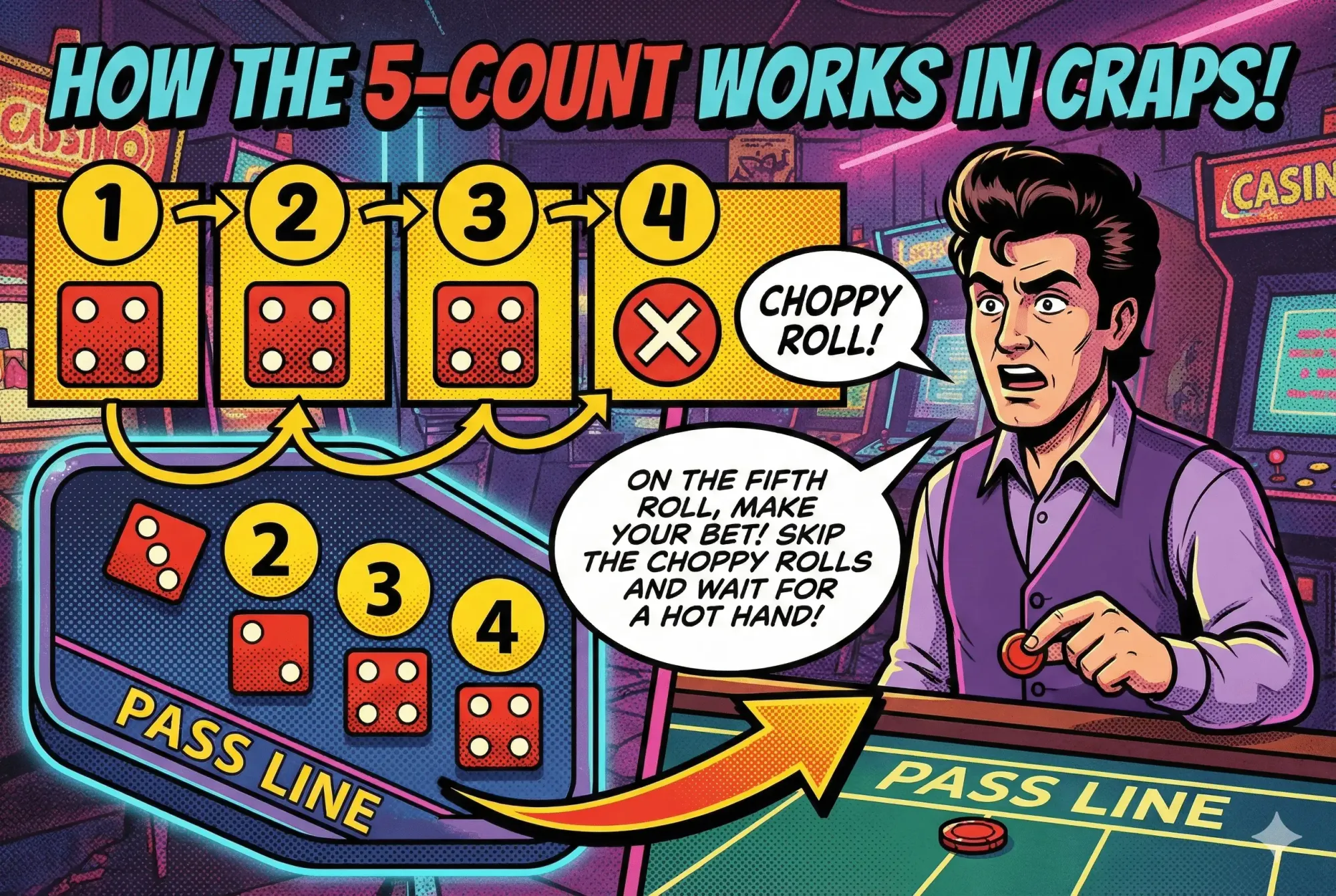
The 5-Count Strategy is a bet-timing and bankroll-management approach commonly associated with craps. Instead of immediately placing several wagers when a new hand begins, the player waits for several qualifying rolls before increasing exposure.
The main idea can be summarized simply:
Wait before committing additional money, so fewer rolls carry active wagers.
This distinction matters because the 5-Count does not identify a mathematically "hot" shooter. It does not make a future 7 less likely and it does not change the house edge of any wager eventually placed.
Its primary purpose is behavioral: it creates a structured delay before the player begins adding bets.
How to Use the 5-Count Strategy
Count 1: Establish the Point
The count begins after a point is established. Standard point numbers are:
- 4
- 5
- 6
- 8
- 9
- 10
Counts 2, 3 and 4
Continue tracking qualifying rolls while keeping additional betting exposure limited. The purpose is not to interpret the sequence as predictive data, but to follow the timing rule consistently.
Count 5
Once the hand reaches the fifth qualifying roll under the chosen version of the system, the player begins the predefined betting plan.
That plan may involve:
- Place 6 and Place 8
- Come bets
- A limited inside-number strategy
- Flat betting with predetermined units
The betting rules should ideally be decided before Count 5 occurs rather than improvised after a winning or losing sequence.
Does the 5-Count Strategy Improve Your Odds?
No. The 5-Count Strategy does not change the mathematical probability of the next dice roll.
Previous rolls do not make a 7 less likely simply because several non-seven results have already occurred.
What the 5-Count may change is the player's betting frequency.
By waiting before placing additional wagers, a player may reduce:
- Total number of bets placed
- Exposure during very short hands
- Impulsive early betting
- Total betting volume during a session
It is therefore better described as a bankroll-control strategy than a dice-prediction strategy.
Bubble Craps Odds and House Edge
Understanding house edge is one of the most useful parts of building a Bubble Craps strategy because different wagers can have very different long-term mathematical costs.
| Bubble Craps Bet | Approximate House Edge | Strategy Consideration |
|---|---|---|
| Don't Pass | About 1.36% | One of the lower-edge base bets under standard rules |
| Pass Line | About 1.41% | Simple foundation bet for beginners |
| Don't Come | About 1.36% | Comparable to Don't Pass after entering play |
| Come | About 1.41% | Similar mathematical structure to Pass Line |
| Place 6 | About 1.52% per resolved bet | Common choice in place-bet strategies |
| Place 8 | About 1.52% per resolved bet | Same mathematical profile as Place 6 |
| Odds Bet | 0% on the Odds portion | Pays according to true odds |
| Many Proposition Bets | Often substantially higher | Usually less efficient for bankroll preservation |
House edge should not be evaluated in isolation. A relatively efficient wager can still generate substantial expected losses when large amounts are repeatedly placed into action.
Why Odds Bets Matter in Bubble Craps
One of the most important mathematical features of craps is the Odds bet.
Once a point has been established, many versions of craps allow an additional wager behind a Pass Line or Come bet. This additional Odds portion is normally paid according to the true probability of the point being made.
That gives the Odds portion itself a 0% house edge.
However, a zero house edge does not mean zero risk.
A player can still lose the full Odds wager, and increasing the amount of Odds taken increases short-term bankroll volatility.
Instead of automatically taking the maximum amount available, a more disciplined approach is to choose an Odds level that fits the size of the session bankroll.
Pass Line vs Don't Pass in Bubble Craps
Pass Line
The Pass Line is one of the easiest craps wagers for new players to understand.
On the Come-Out roll:
- 7 or 11 normally wins
- 2, 3 or 12 normally loses
- 4, 5, 6, 8, 9 or 10 establishes the point
Once a point is established, the Pass Line wins if the point repeats before a 7 appears.
Don't Pass
Don't Pass generally takes the opposite side after the point is established. Under standard rules, its house edge is slightly lower than the Pass Line.
The mathematical difference is small enough that bankroll discipline, total betting volume and bet size can have a much larger influence on session volatility than simply choosing one of these two base bets.
Bubble Craps Strategy
Why Bubble Craps Players Often Focus on 6 and 8
Place 6 and Place 8 are popular because both numbers can be formed in five different combinations using two standard six-sided dice.
Compare the common point numbers:
- 4: 3 combinations
- 5: 4 combinations
- 6: 5 combinations
- 8: 5 combinations
- 9: 4 combinations
- 10: 3 combinations
This means 6 and 8 are more likely to appear on an individual roll than 4 or 10.
However, higher frequency does not make Place 6 or Place 8 guaranteed winners. Both remain casino wagers with a house edge.
11 Bubble Craps Tips for Smarter Bankroll Management
1. Start With Fewer Active Bets
One of the easiest mistakes in Bubble Craps is covering too many numbers at once.
The touchscreen makes it easy to add wagers quickly, which can hide how much money is actually exposed before the next roll.
A player might simultaneously have money on:
- Pass Line
- Odds
- 5
- 6
- 8
- 9
- Field
- Hardways
Each wager may appear small on its own, but the combined exposure can become substantial.
Begin with a smaller, easier-to-track betting structure instead.
2. Avoid Making Proposition Bets the Core of Your Strategy
Proposition bets such as Any 7, Any Craps, Hardways and other one-roll combinations can be entertaining, but many carry significantly higher house edges than Pass Line, Don't Pass or Place 6 and 8.
Players focused on bankroll efficiency should treat these wagers as optional entertainment rather than the foundation of a Bubble Craps strategy.
3. Control the Faster Betting Pace
Bubble Craps often removes many delays found at a traditional table, including dealer payouts, manual chip handling and table conversations.
That can result in more betting decisions during the same amount of time.
A useful simplified concept is:
Expected theoretical loss ≈ total amount wagered × house edge
This means that even if a player chooses relatively low-edge wagers, repeatedly placing more money into action can still increase expected cost.
Betting pace is therefore an important part of Bubble Craps bankroll management.
4. Use a Fixed Session Bankroll
Decide how much money belongs to one gambling session before beginning.
Do not automatically treat an entire account balance as available betting capital.
Dividing a larger gambling budget into smaller session bankrolls can make limits easier to follow and reduce the temptation to continually add funds after losses.
5. Set Betting Units Before the First Roll
Rather than changing wager size emotionally after each result, define a standard betting unit in advance.
For example:
- 1 unit = normal base wager
- 2 units = planned moderate increase
- 3 units = maximum predefined exposure on a single position
The exact monetary value depends on the player's bankroll.
The advantage of unit-based management is consistency, especially after a losing sequence.
6. Understand Pressing Before Increasing Bets
A press means increasing a wager after a win.
Pressing can create larger returns during a favorable sequence, but it also puts more previously won money back at risk.
Most importantly, the fact that a bet just won does not make another win more likely.
If pressing is part of your strategy, consider using a predefined structure such as:
- Collect the first win
- Press only part of a later win
- Cap the maximum number of units at risk
- Return to the base wager after reaching the predefined limit
7. Use Regression to Reduce Future Exposure
Regression works in the opposite direction to pressing.
Instead of increasing bets after a successful hit, the player reduces future wager size.
The purpose is to recover part of the initial exposure while keeping smaller positions active.
Regression can reduce future money at risk, but it does not change the house edge of the bets that remain.
8. Do Not Chase Roll History
Many electronic craps games display a history of recent dice results.
That history may be useful for:
- Tracking a session
- Following the 5-Count
- Reviewing recent outcomes
- Understanding the flow of play
It should not be treated as a prediction tool.
A 7 does not become mathematically "due" because several rolls occurred without one.
9. Avoid the Gambler's Fallacy
The gambler's fallacy occurs when players assume previous random outcomes change what should happen next.
Common examples include:
- "A 7 hasn't appeared recently, so it must be coming soon."
- "6 has hit several times, so 6 is hot."
- "There were several short hands, so a long one is due."
These patterns may feel meaningful, but they do not create a reliable mathematical advantage.
10. Use Stop-Loss and Stop-Win Rules as Behavioral Limits
A stop-loss defines how much of the session bankroll a player is willing to lose before ending play.
A stop-win defines a point at which the player considers ending a profitable session.
Neither rule changes the mathematical expectation of the game.
Their purpose is to prevent the session from continuing indefinitely because of frustration, excitement or loss chasing.
11. Do Not Confuse Lower Minimum Bets With Lower Total Risk
Bubble Craps may offer smaller minimum wagers than some traditional tables, which can be useful for bankroll control.
However, lower minimums do not automatically mean lower total exposure.
A player repeatedly making small wagers across several positions at a fast pace can ultimately put more money into action than a player making fewer, larger bets.
Always track total exposure, not just the minimum amount displayed on the terminal.

Press vs Regress vs Flat Betting
| Strategy | Main Purpose | Main Trade-Off |
|---|---|---|
| Press | Increase exposure after wins | More winnings are returned to risk |
| Regress | Reduce exposure after wins | Limits upside during long favorable sequences |
| Flat Betting | Keep wager size consistent | Less aggressive profit growth during streaks |
| 5-Count | Delay additional betting | Some winning rolls occur while the player is waiting |
None of these systems changes the probability of the dice.
Their main differences involve when money is put at risk and how quickly wager size changes.
Common Bubble Craps Strategy Mistakes
Improving a Bubble Craps strategy is often more about avoiding expensive mistakes than discovering a secret betting system.
Common mistakes include:
- Covering too many numbers simultaneously
- Increasing wager size immediately after losses
- Assuming roll history predicts future outcomes
- Using proposition bets too frequently
- Pressing every win without a limit
- Confusing a winning streak with a mathematical edge
- Ignoring total money at risk
- Betting faster simply because the interface allows it
- Continuing after reaching a predefined session limit
Avoiding these mistakes does not guarantee profit, but it can make play more controlled and mathematically efficient.
Can You Beat Bubble Craps?
There is no standard betting system that guarantees a long-term profit in Bubble Craps.
The casino maintains a mathematical advantage on most wagers.
Odds bets are unusual because the additional Odds portion is normally paid at true odds, but the underlying Pass Line, Don't Pass, Come or Don't Come wager still carries its own house edge.
A realistic Bubble Craps strategy therefore aims to:
- Choose lower-cost wagers
- Reduce unnecessary betting volume
- Manage short-term variance
- Protect the session bankroll
- Avoid high-house-edge mistakes
Is Bubble Craps Better Than Live Craps for Strategy?
Bubble Craps may be easier for some players who prefer to focus on betting mechanics without the social pressure of a traditional craps table.
Potential advantages include:
- Personal touchscreen controls
- Clear wager displays
- Easier bet adjustment
- Automatic settlement
- Potentially lower minimum wagers
- Less pressure from experienced table players
Traditional craps offers a more social atmosphere and often a naturally slower rhythm.
From a bankroll perspective, the faster pace of Bubble Craps makes disciplined bet sizing particularly important.
Practicing Craps Strategies Online
Players who want to understand craps betting systems should focus on learning wager mechanics before increasing stakes.
When comparing digital casino environments, useful factors to check include:
- Minimum and maximum wager limits
- Available Odds multiples
- Payout rules
- Betting interface clarity
- Game history features
- Deposit and withdrawal terms
- Responsible gaming controls
A broader bitcoin casino environment may provide access to multiple digital casino formats, but players should still evaluate each game's house edge, volatility and wagering rules separately rather than assuming every game carries the same mathematical risk.
For players specifically interested in dice mechanics, bitcoin craps provides a more relevant starting point for understanding how common craps wagers behave in an online setting.
When testing any strategy, begin with smaller wager sizes and focus on whether the betting structure is easy to follow across both winning and losing sequences.
A successful short session does not prove that a strategy can overcome the house edge.
Frequently Asked Questions About Bubble Craps Strategy
What is the best bet in Bubble Craps?
Under standard craps rules, Pass Line, Don't Pass, Come, Don't Come, Place 6 and Place 8 generally offer more favorable mathematical profiles than many proposition bets.
The Odds portion of an eligible wager is particularly notable because it is normally paid according to true odds.
Does the 5-Count Strategy really work?
The 5-Count can work as a bankroll-control technique because it reduces the number of rolls during which additional money is exposed.
It does not predict future dice outcomes and does not reduce the house edge of the bets placed after the count is complete.
What numbers should you place in Bubble Craps?
Players using Place bets commonly focus on 6 and 8 because each number can be formed in five combinations with two six-sided dice.
Both wagers still carry risk and a casino advantage.
Is Bubble Craps rigged?
Players should use games provided through appropriately regulated environments and review the published rules and payout information.
Recent roll history should not be treated as evidence that future results can be reliably predicted.
Are Bubble Craps odds different from regular craps?
The probability of two standard six-sided dice does not change because the betting interface is electronic.
However, payout tables, Odds limits, minimum bets and available wager types can vary between games and operators.
Should you always take maximum Odds?
Not necessarily.
The Odds portion may carry a 0% house edge, but a larger Odds wager also increases the amount of bankroll exposed to each decision.
The appropriate amount depends on bankroll size and tolerance for short-term variance.
Can roll history help predict Bubble Craps?
Roll history can help track a session or follow a structured betting method, but previous independent results do not provide a reliable prediction of the next dice roll.
Final Bubble Craps Strategy: Keep the System Simple
The most useful Bubble Craps tips are usually straightforward.
A disciplined strategy can be built around a few core principles:
- Prioritize relatively low-house-edge wagers
- Keep the number of active bets manageable
- Use Odds only at a level the bankroll can support
- Treat the 5-Count as a betting-delay strategy rather than a prediction system
- Avoid making proposition bets the core of your approach
- Use predefined press or regression rules
- Do not chase previous losses
- Ignore supposed hot and cold patterns
- Control the speed of your betting
- Set session limits before play begins
Bubble Craps remains a casino game with an inherent mathematical house advantage. No betting system can guarantee profit or remove the risk of losing.
What a well-structured Bubble Craps strategy can do is help players understand where the mathematical cost comes from, avoid unnecessarily expensive wagers and make more deliberate bankroll decisions.
Responsible Gaming
Gambling should be treated as entertainment rather than a reliable source of income. Only wager funds you can afford to lose, set clear financial and time limits before playing, and stop if gambling is no longer enjoyable or controlled.