








If you didn't tune in to the live FIFA today, a quick glance at the final scoreline might leave you thinking everything went exactly as expected. After all, on paper, it seems only natural for a decorated, former World Cup champion to edge out an African underdog. But that comfortable assumption is precisely why we need to talk—because what the scoreboard hides is the exact reason the global football community is in absolute uproar today.
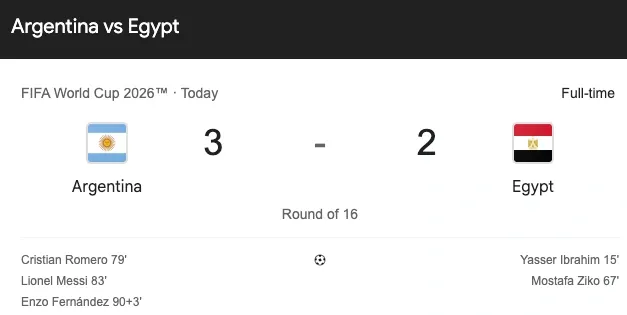
On July 7, 2026, at the Atlanta Stadium, the world witnessed what the mainstream media is already branding a "breathtaking, historic World Cup comeback." Argentina 3, Egypt 2. To the casual observer, to the billions of non-football fans tuning in for the global spectacle, it looked like the beautiful game at its finest: Lionel Messi’s legendary side fighting against adversity to secure a spot in the Quarter-Finals. But if you strip away the cinematic slow-motion replays, the emotional commentary, and the corporate marketing veneer, you are left with something deeply sinister.
As an insider—someone who operates at the executive level of the sports betting and casino industry—I watched this match with a heavy heart and a sense of profound disgust. While the stadiums roar and the fans cheer, those of us behind the sportsbooks watch a completely different game. We look at moving lines, sudden spikes in live-betting volume, and most importantly, the clinical execution of narrative control by the match officials. What happened in Atlanta was not a sporting contest; it was a multi-million-dollar theater production orchestrated by referee François Letexier.
This manifesto is written not just for the hardcore football fan who understands tactical nuances, but for the global citizen who doesn't know a penalty kick from a corner kick. The world needs to understand exactly what transpired on that pitch, why the modern sports industry has become a carefully manicured illusion, and why—now more than ever—ordinary citizens must approach sports gambling with absolute caution, rationality, and skepticism. The house always wins, but even the house feels dirty after a heist this blatant.
What is FIFA's VAR?
In football, VAR stands for Video Assistant Referee.
Rather than just a piece of technology, it is a specialized team of active match officials who assist the referee on the pitch using video replay technology. Here is a breakdown of how it operates and why it is so heavily discussed.
1. How Does It Work?
During a match, the VAR team—located in a centralized Video Operation Room (VOR) surrounded by high-definition monitors—watches the game from multiple camera angles in real time. If a controversial incident occurs, they communicate directly with the head referee on the pitch via a wireless headset.
2. When Can VAR Intervene?
To avoid constantly interrupting the flow of the game, FIFA rules dictate that VAR can only intervene to review "clear and obvious errors" or "serious missed incidents" relating to four match-changing categories:
- Goal / No Goal: Checking for infractions, offsides, or whether the ball went out of bounds in the buildup to a goal.
- Penalty / No Penalty: Reviewing whether a penalty should be awarded, or if a given penalty was a mistake.
- Direct Red Card: Checking for serious foul play, violent conduct, or spitting (this does not apply to a second yellow card).
- Mistaken Identity: Ensuring the referee cautions or expels the correct player when handing out a card.
3. Who Has the Final Say?
The On-Field Referee. The VAR team only acts in an advisory capacity. They can suggest that the main referee review a play, prompting the referee to jog over to the pitchside monitor for an On-Field Review (OFR). Ultimately, the final decision always rests entirely with the referee on the pitch.
4. Why is it So Controversial Today?
While the original purpose of VAR was to bring absolute fairness to football, its execution often sparks furious debates (as seen in the extreme scenarios of the Argentina vs. Egypt match). Critics argue that it is prone to "selective intervention" and "double standards." A referee can use ultra-slow motion to penalize a microscopic, routine challenge from 45 seconds ago to disallow a goal, yet completely refuse to consult the monitor when a game-deciding penalty claim occurs at the death.
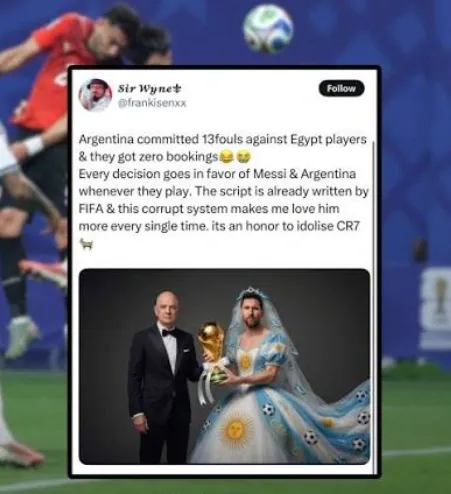
Anatomy of an Execution — The Three Critical Slashes
To understand how a match is manipulated, you must realize that corrupt or directed refereeing is rarely about making one massive, undeniably fake call that everyone catches instantly. Instead, it is a game of microscopic incrementalism—chipping away at one team's morale, momentum, and physical capabilities while offering hidden structural safety nets to the other. Letexier executed a three-stage assassination of Egypt’s World Cup dream.
1. The Disallowed 2-0: Weaponizing the VAR Archive
The On-Field Reality: In the 58th minute, Egypt was already leading 1-0 thanks to an early defensive error by Argentina. The underdogs launched a breathtaking counter-attack. The legendary Mohamed Salah bypassed two defenders before feeding a pinpoint pass to Mostafa Ziko, who calmly slotted the ball past the Argentine goalkeeper. The Egyptian bench exploded; fans in Cairo were tearing down the streets in joy. A 2-0 lead against Argentina in a World Cup knockout match is an almost insurmountable mountain.
However, before the ball could even be returned to the center circle, the Video Assistant Referee (VAR) intervened. Letexier was instructed to review the footage on the pitchside monitor. He didn't look at the goal itself, nor the pass, nor the run. Instead, he was instructed to rewind the tape nearly 45 seconds prior to a routine, physical 50-50 shoulder challenge in the midfield where Egypt initially won possession. Letexier watched the clip in ultra-slow motion—a medium that makes even the most innocent touch look violent—and retroactively declared it a foul. The goal was erased. The score was forcefully reverted to 1-0.
The Structural Conclusion: This was a masterclass in "microscopic policing" used as a tactical weapon. Under the strict, pedantic interpretation of the International Football Association Board (IFAB) laws, VAR can check the attacking phase of play. But in a high-intensity World Cup match, hundreds of these minor physical contacts happen every ten minutes and are routinely waved off as "healthy aggression." To selectively dig into the digital archives to find a minor infringement solely because a goal was scored is malicious compliance. It completely shattered Egypt's psychological ascendancy and kept Argentina within a single-goal striking distance without them having to earn it on merit.
2. The 5-0 Card Monopolization and Tactical Asphyxiation
The On-Field Reality: Following the disallowed goal, Argentina threw everything forward, leaving massive gaps in their defense. To halt Egypt's dangerous counter-attacks, Argentine defenders—specifically Cristian Romero and Rodrigo De Paul—resorted to blatant tactical fouling, cynical tripping, and late jersey-tugging. These are text-book yellow card offenses designed to stop a breaking opponent. Letexier repeatedly waved his hands, signaling to "play on."
Conversely, the moment an Egyptian jersey made the slightest physical contact with an Argentine superstar, Letexier’s whistle blew instantly. When Egypt's midfield tried to match Argentina's intensity, they were met with an immediate barrage of disciplinary action. In a dizzying ten-minute window during Argentina's equalizer push, Letexier issued yellow cards to five crucial Egyptian players, including goalkeeper Mostafa Shobeir for alleged time-wasting and Hamdi Fathi for a standard tackle. He topped it off by red-carding an Egyptian assistant coach who dared to scream from the technical area. By the time the final whistle blew, the card count read: Egypt 5, Argentina 0.
The Structural Conclusion: This is what industry insiders call "asphyxiation by whistle." When an underdog relies on physical intensity, defensive discipline, and high-energy pressing to neutralize a team of multi-millionaire superstars, the referee can destroy that entire strategy without awarding a penalty. By giving five yellow cards to one side and zero to the other, Letexier effectively told the Egyptian defense: "If you touch them again, you are sent off." He stripped them of their ability to defend aggressively, while giving Argentina a license to foul with complete impunity. It fractured the competitive balance of the sport.
3. The Phantom 9-Minute Extra Time and the Denied Death-Blow Penalty
The On-Field Reality: The second half was unusually fluid. There were no major medical emergencies on the pitch, no pitch invaders, and substitutions were carried out with extreme efficiency. Yet, when the fourth official raised the electronic board, it displayed a staggering 9 minutes of injury time. It was an arbitrary number manufactured out of thin air to give Argentina as much time as possible to find a winner.
In the 93rd minute, Enzo Fernández scored to make it 3-2 for Argentina. But the ultimate scandal occurred in the 99th minute. With seconds left on the phantom clock, Egypt threw their entire team into the Argentine penalty box. During a chaotic aerial duel, an Egyptian forward cleanly controlled the ball before his standing leg was violently swept away by an Argentine defender's desperate sliding tackle. It was a stonewall, undeniable penalty. The entire stadium gasped. The Egyptian players fell to their knees begging for a review. Letexier put his hand to his earpiece, listened to the VAR room for three seconds, refused to walk to the monitor, waved his arms, and blew the final whistle to end the match.
The Structural Conclusion: Selective blindness of the highest order. The very same VAR system that was utilized with surgical precision to scan 45 seconds of tape and rob Egypt of a 2-0 lead was completely shut down when it threatened to award Egypt a last-second penalty that could have sent the match to extra time. The asymmetry of justice on that field was mathematical proof that a specific outcome was being protected.

The Casino Operator's Confession — Why This Result Ruins the Ecosystem
There is a widespread, naive belief among the general public that casino owners and sportsbook operators love these kinds of fixed or heavily manipulated matches. People assume that because the powerhouse "won," the house raked in the cash. Let me dispel that myth right now: As an operator, this result fills me with profound dread and disappointment.
A legitimate sportsbook functions on mathematical equilibrium and predictability. We make our money on the "juice" or the "vigorish"—the small transaction fee built into the odds. Our ideal scenario is a completely fair, unpredictable match where public money is split evenly down the middle, allowing us to pay out the winners with the losers' money and pocket a guaranteed percentage risk-free.
When a match is heavily manipulated by officiating, it throws the entire ecosystem into chaotic volatility. As Egypt took the lead, the live-betting algorithms began adjusting the odds, making an Argentina comeback highly lucrative. Suddenly, massive, multi-million-dollar spikes of live-betting volume flooded our platforms from highly specific, concentrated accounts—smart money that knew with absolute certainty that Argentina wouldn't be allowed to lose. When a referee starts calling back goals and handing out unreciprocated yellow cards, the natural risk distribution of our book is completely destroyed, creating massive, artificial liabilities for the house.
More importantly, blatant displays of corruption destroy our most valuable asset: consumer trust. If a non-fan or a casual punter tunes into the 2026 World Cup and realizes within five minutes that the match is operating on a predetermined script, they don't just stop watching football—they delete their betting apps. They realize that they aren't wagering on a sporting event; they are throwing their hard-earned money into a rigged carnival game. For anyone looking to understand the inner workings of online platforms, exploring a crypto casino offers a clear look at how decentralized technologies handle global transaction volumes. When the illusion of fairness dies, our industry dies with it.
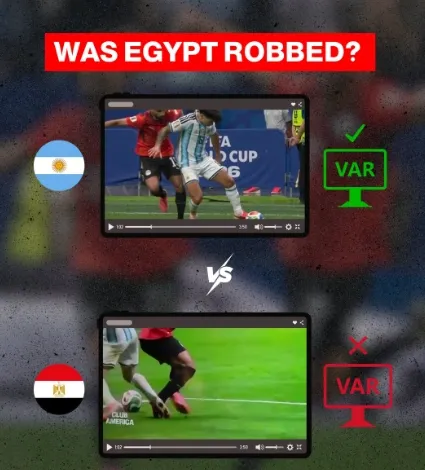
The Dark Trinity — Why Was the Script Enforced?
For the billions of people worldwide who are trying to make sense of why a referee would risk his global reputation to alter the course of a World Cup match, the answers lie within three deeply entrenched, hidden power structures that govern modern global sports. It is a mix of syndicate money, entertainment capitalism, and systemic geopolitical bias.
1. The Infiltration of Global Gambling Syndicates
The sheer scale of the legal and illegal global gambling market during a World Cup knockout stage is almost unfathomable. We are talking about tens of billions of dollars swirling through European, Caribbean, and unregulated Asian betting markets for a single 90-minute match.
When Egypt took a 1-0 lead and began threatening a 2-0 lead, panic rippled through major international betting syndicates that had heavily backed Argentina to win the tournament or advance in regular time. In the unregulated underbelly of sports betting, syndicate leaders don't leave their margins to chance. They leverage immense financial power over match officials through complex networks of offshore accounts, untraceable cryptocurrency transfers, and subtle coercion. Players looking for the highest payouts often turn to the best bitcoin casinos, where higher table limits and rapid liquidity match the needs of heavy rollers. A referee like Letexier doesn't need to be handed a briefcase of cash in a dark alley; the financial reward is digitized, compartmentalized, and distributed globally. When billions of dollars face elimination because an underdog is playing too well, the referee's whistle becomes the ultimate financial market correction tool.
2. FIFA’s Multibillion-Dollar Entertainment Blueprint
Let us look at this through the lens of cold, calculating corporate capitalism. This is the 2026 World Cup, hosted across North America—the largest commercial market on Earth. More importantly, this is almost certainly the final World Cup tournament for 39-year-old Lionel Messi, the most commercially lucrative athlete in human history.
From a corporate standpoint, FIFA is not a sports governing body; it is an entertainment conglomerate. An Argentina team crashing out in the Round of 16 to a modest African side like Egypt is an absolute economic disaster. It immediately tanks the television ratings for the upcoming Quarter-Finals and Semi-Finals across Europe, the Americas, and Asia. It devalues prime-time advertising slots that major global brands paid hundreds of millions for. It cools down the resale ticket market in American stadiums from thousands of dollars to face value. For international enthusiasts wanting to participate in these massive sporting markets, setting up an account at an offshore betting site allows them to bypass regional licensing hurdles and access broader market margins. FIFA, its broadcasting partners, and its corporate sponsors desperately needed the "Messi's Last Dance" narrative to survive into the deep stages of the tournament to maximize global engagement, merchandising sales, and media clicks. The referee simply understood the corporate assignment: protect the asset, protect the product, protect the revenue.
3. Systemic Euro-Centric and Regional Bias
For the non-fans looking from the outside, it is vital to recognize that football suffers from a deep-seated, institutional caste system. The elite governing bodies, the powerful refereeing committees, and the dominant media narratives are overwhelmingly controlled by an old-guard axis of European and South American nations.
African football, despite producing some of the greatest athletes on the planet, has historically been marginalized and treated with an underlying, systemic paternalism. When an African team like Egypt faces a traditional powerhouse like Argentina, a subconscious (and sometimes conscious) bias manifests in elite Western referees. They possess an inherent, arrogant assumption that the European/South American giants belong in the final chapters of the tournament, while the African underdogs are merely seasonal guests who should be grateful to be there. This structural bias translates directly onto the pitch: an Argentine tackle is viewed as "world-class grit," while an identical Egyptian tackle is interpreted as "naive, reckless, and undisciplined." Those looking for alternative, non-restricted digital gaming environments often seek out the best casinos not on gamstop, where traditional restrictive regulatory frameworks do not interfere with consumer choice. Egypt wasn't just playing against eleven men in light blue and white stripes; they were playing against a century of deeply rooted geopolitical football aristocracy.
A Direct Warning to Global Citizens — Bet with Absolute Sanity
If you are someone who rarely watches football but decided to download a gambling application to participate in the global hype of the 2026 World Cup, or if you are a veteran punter who is currently reeling from losing money on Egypt's valiant effort, I am issuing you a stark, unvarnished warning: You must alter how you engage with this tournament immediately. You must bet with absolute caution, rationality, and strict financial boundaries.
The romantic myth of the "pure sporting contest" where the harder-working, tactically superior team wins on merit is dead. It has been replaced by a highly optimized, hyper-capitalist entertainment product where the lines between organic sport and manufactured drama are completely blurred. There are too many corporate interests, too many broadcasting contracts, and too many international financial syndicates pulling the strings behind closed doors for the outcomes to be left entirely to the chaotic bounce of a ball.
When you place a wager on a major international sporting event today, you are not just betting on the athletic performance of the players; you are betting on whether or not your chosen outcome aligns with the financial and narrative goals of the trillion-dollar industry backing it. If your bet threatens to disrupt the preferred corporate script, you are exposing your bankroll to the whim of a referee who has the unchecked power to erase goals, manufacture injury time, and turn a blind eye to clear infractions inside the penalty box.
Treat sports betting for what it truly is: a form of highly volatile, high-risk entertainment, not a fair environment where knowledge equals profit. Never chase your losses, never bet capital that is essential to your livelihood under the assumption that a powerhouse team is a "sure thing," and always maintain a healthy, cold skepticism when watching the drama unfold on your screen. Enjoy the breathtaking athleticism of the players, marvel at the global spectacle of the crowds, but never forget that underneath the beautiful game lies a massive, calculated, and unforgiving machine that will gladly break the heart of an entire nation just to keep its gears turning.