







Padel and tennis can look remarkably similar from a distance. Both use rackets, a net, familiar point scoring, service boxes, and many of the same basic shot concepts. Step onto a padel court, however, and the similarities quickly give way to a very different game.
The smaller enclosed court, solid racket, underarm serve, wall rebounds, and doubles-focused format change everything from positioning to shot selection. A powerful tennis player may have obvious transferable skills, but simply bringing tennis tactics onto a padel court rarely produces the best results.
This guide compares padel vs tennis in 2026, breaking down the rules, court dimensions, equipment, serving, scoring, movement, tactics, and learning curve so beginners can understand exactly where the two sports overlap—and where they separate.
Padel vs Tennis: The Quick Comparison
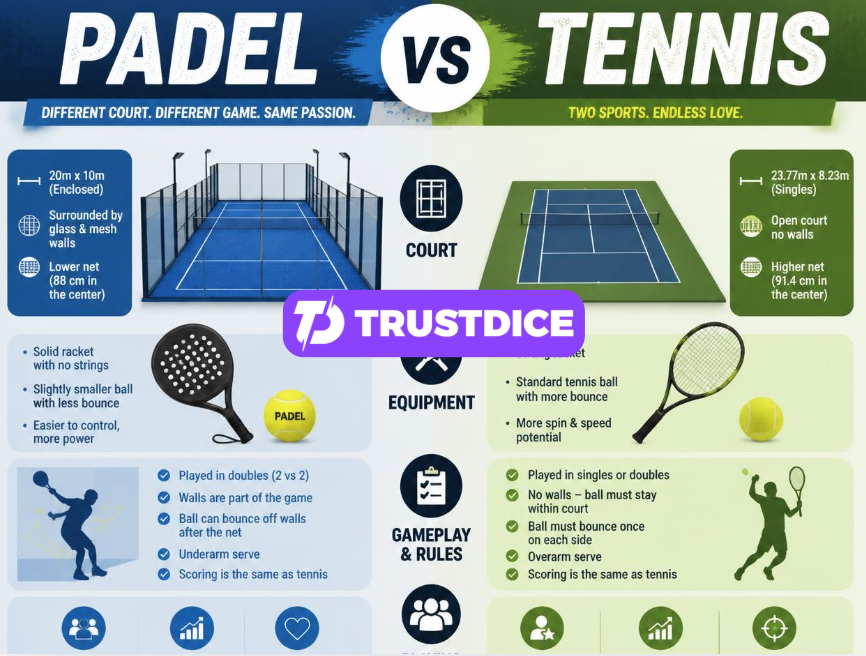
The fastest way to understand the difference is through the playing environment. Tennis gives players a large open court. Padel places four players inside a compact enclosure where glass rebounds are part of the rally.
| Feature | Padel | Tennis |
|---|---|---|
| Typical Format | Doubles | Singles or doubles |
| Standard Court | 20 × 10 meters | Larger open court |
| Racket | Solid perforated racket | Strung racket |
| Serve | Underarm after a bounce | Overhead |
| Walls | Part of gameplay | Not part of gameplay |
| Scoring | Tennis-style structure | 15, 30, 40, game |
Quick Take 🎯
Tennis rewards the ability to create and defend space across an open court. Padel adds another dimension: players must understand how the ball interacts with the enclosure while coordinating constantly with a partner.
Padel Courts Are Smaller—but the Walls Change Everything
A standard padel court measures 20 meters long and 10 meters wide. Tennis courts are considerably larger, particularly when comparing the space a singles player must cover.
That might make padel sound physically simpler, but the enclosure changes how players perceive space. A deep ball is not automatically finished just because it passes the defender. If it bounces legally and reaches the back glass, the defender may use the rebound to continue the rally.
This creates situations that do not exist in conventional tennis. Experienced padel players sometimes deliberately move away from an incoming ball because they know the glass will return it into a more comfortable hitting position.
For tennis players switching sports, learning not to attack every ball before it reaches the wall is one of the biggest adjustments.
Padel Racket vs Tennis Racket
The equipment looks related, but the racket design is fundamentally different.
A tennis racket has strings and a relatively large hitting area. A padel racket is shorter and uses a solid perforated face. Different shapes and weight distributions can emphasize control, balance, or attacking characteristics.
| Equipment | Padel | Tennis |
|---|---|---|
| Racket Face | Solid with holes | Strings |
| Racket Length | More compact | Longer |
| Typical Beginner Focus | Control and maneuverability | Control, power and appropriate head size |
| Ball | Designed for padel specifications | Standard tennis ball specifications |
Players coming from tennis often discover that generating maximum racket-head speed is less important than expected. Because rallies take place in a smaller environment, reaction time, touch, placement, and compact technique become extremely valuable.
The Serve Is Completely Different
The tennis serve can be a major offensive weapon. At elite level, a dominant server may win points or create weak returns before a normal rally has properly developed.
Padel deliberately reduces that dynamic through an underarm serve. The server bounces the ball and strikes it according to the permitted serving height, sending it diagonally into the correct service box.
The objective is usually not to blast an ace. Placement and the transition into the next phase of the point are more important.
⚔️ Player Insight: If you come from tennis, treat the padel serve as the beginning of a tactical sequence rather than a standalone power shot. A controlled serve followed by good positioning is often more useful than unnecessary speed.
Scoring Is Where Tennis Players Feel at Home
Scoring is one of the easiest areas for tennis players to transfer their knowledge. Traditional padel uses the familiar 15, 30, 40 and game structure, with games forming sets.
Matches are commonly played over the best of three sets, although specific tournament regulations may introduce different procedures for deciding points or tie-break situations.
Because competition formats can vary, checking the rules of a particular professional event remains important rather than assuming every match uses an identical system.
Padel Is More Focused on Doubles Teamwork
Tennis has major singles and doubles disciplines. Padel, by contrast, is overwhelmingly associated with doubles.
This changes the tactical mindset. You are not simply responsible for your own side of the court. Every movement affects the space available to your partner.
In our analysis of competitive rallies, poor spacing is one of the easiest weaknesses to identify. When one player attacks while the partner remains too deep, a diagonal gap opens between them. Skilled opponents can repeatedly target that space.
Better pairs move forward and backward together, almost as if an invisible line connects them.
Pro Tip 🏆
Do not judge your position independently. Ask whether your position makes sense relative to your partner. In padel, two coordinated players usually cover the court more effectively than two individually talented players moving without a shared structure.
Power Matters Less Than Many Tennis Players Expect
A powerful forehand is obviously useful, but padel frequently punishes uncontrolled aggression.
Why? The enclosure can return hard shots. A ball smashed without enough angle or tactical purpose may rebound into a playable area and give the opponents another opportunity.
Control therefore becomes essential. Players use lobs to push opponents away from the net, volleys to maintain pressure, and specialized overhead shots to manage difficult situations.
The goal is often to create a progressively stronger position rather than finish every point immediately.
Why the Lob Is So Important in Padel
In recreational tennis, beginners sometimes view a lob as an emergency shot. In padel, it is a fundamental tactical weapon.
Suppose the opposing pair controls the net. Driving the ball directly at them may simply provide another easy volley. A well-placed lob can force both players backward, giving your team time to move forward and challenge for net control.
This constant battle for position defines many rallies.
Once you start watching padel this way, matches become easier to analyze. Rather than counting spectacular winners, watch which pair controls the net, who is repeatedly forced backward, and how effectively each team converts defensive situations into attacking ones.
Padel vs Tennis for Match Analysis
The differences between the sports also matter when evaluating professional competition. Tennis analysis often places substantial attention on serving performance, return quality, surface, baseline patterns, and individual matchups.
Padel adds pair chemistry and coordinated positioning to the equation. A strong individual player can still struggle if the partnership is repeatedly exposed tactically.
For people researching padel betting, understanding these differences provides more context than simply transferring assumptions from tennis. Recent pair performance, tactical compatibility, tournament conditions, injuries or lineup changes, and the characteristics of the opposition can all influence how a match develops.
Markets can also differ between events, so available odds should be treated as market information rather than guarantees about future results.
Is Padel Easier Than Tennis?
For many beginners, padel has a more accessible starting point. The underarm serve removes one technically demanding skill, the smaller court reduces the amount of open ground players must cover, and new players can often sustain basic rallies relatively quickly.
But easier to start does not mean easy to master.
Advanced padel requires precise wall reading, quick reactions, coordinated movement, sophisticated overhead technique, net control, and strong tactical decision-making.
Tennis has its own demanding technical and physical requirements, particularly when serving, covering a singles court, and generating consistent groundstrokes under pressure. The better comparison is therefore accessibility rather than absolute difficulty.
Which Skills Transfer from Tennis to Padel?
Tennis players do have a significant head start in several areas. Hand-eye coordination, volley technique, basic footwork, anticipation, racket awareness, and familiarity with scoring can all transfer.
The challenge is knowing what to modify.
Long tennis swings may become awkward during fast exchanges. Overly aggressive baseline positioning can ignore the tactical importance of the net. Most importantly, tennis instincts do not automatically teach a player how to defend using glass rebounds.
In high-level playtests and match observation, adaptation tends to matter more than simply importing existing technique unchanged.
Following Padel Online Safely
The expansion of professional padel has also increased the number of online platforms covering matches and related gaming markets. Users should verify domains carefully before entering account details, particularly when accessing a service through an alternative address.
References to crypto casino mirror sites should be checked against trusted platform information instead of relying on unsolicited third-party links.
The same applies when looking for a trustdice mirror site. Domain verification is a basic security step regardless of which sport or market you are following.
Padel vs Tennis FAQ
Is padel basically tennis with walls?
No. Although the sports share scoring and several racket-sport concepts, the court, equipment, serve, wall rules, doubles structure, and tactical patterns make padel a distinct sport.
Can tennis players learn padel quickly?
Many tennis skills transfer effectively, but players still need to learn wall rebounds, shorter swing patterns, pair positioning, and padel-specific tactics.
Does padel use the same scoring as tennis?
Traditional scoring is very similar, including the familiar 15, 30 and 40 progression. Exact competition formats can vary.
Which sport uses a bigger court?
Tennis uses the larger playing area. A standard padel court measures 20 × 10 meters and is enclosed.
Final Thoughts
Padel and tennis share enough DNA to feel familiar, but they reward different instincts. Tennis gives players more open space and places greater emphasis on elements such as the overhead serve and individual court coverage, especially in singles. Padel compresses the action and adds walls, constant doubles coordination, and an intense battle for net position.
For beginners moving from tennis, the biggest adjustment is often psychological: stop treating every deep ball as an emergency and stop assuming harder is always better. Learn to use the glass, move with your partner, build points patiently, and use the lob strategically.
Once those habits develop, padel stops feeling like a variation of tennis. Its own tactical identity becomes obvious—and that is where the sport gets considerably more interesting.