







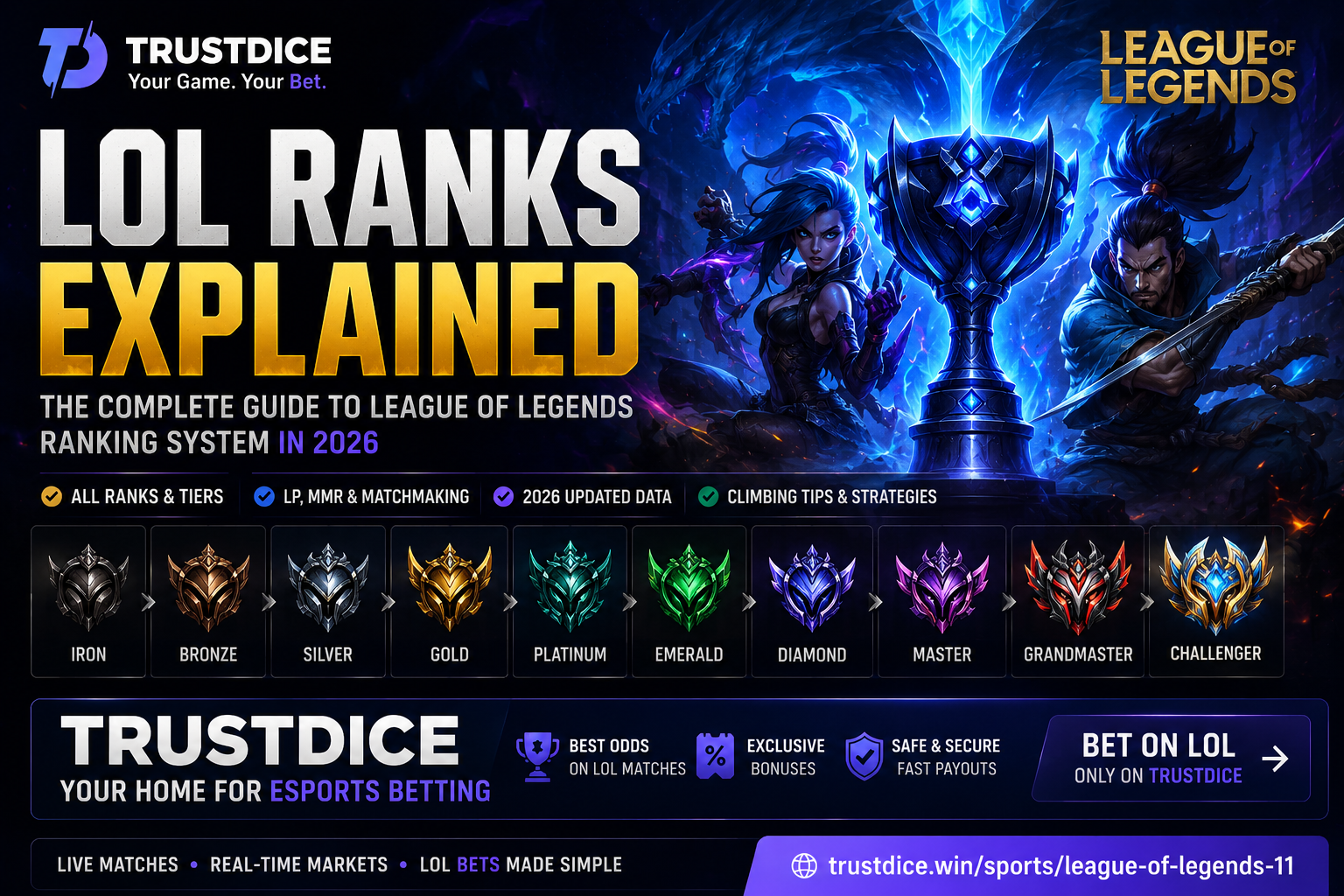
The lol ranks system in 2026 is more than a simple climb from Iron to Challenger. Riot Games has continued refining ranked matchmaking, LP gains, hidden MMR, autofill balance, queue quality, and skill distribution to make ranked play feel more accurate and competitive.
Whether you are trying to escape Silver, push into Emerald, reach Diamond, or understand professional League before exploring betting on lol, knowing how the ranked system works is essential.
“In modern League of Legends, climbing is not just about playing more games — it is about understanding LP, MMR, champion mastery, macro decisions, and ranked consistency.”
This updated 2026 guide explains every current rank, how LP works, why MMR matters, what Emerald means, how rank distribution looks, and how players can climb lol ranks more efficiently in the current season.
2026 Ranked Snapshot 📊
- Highest Rank: Challenger
- Newest Permanent Tier: Emerald
- Most Populated Ranks: Silver and Gold
- Top 2%: Diamond and above
- Top 0.03%: Challenger
What Are LoL Ranks?
LoL ranks represent a player’s competitive skill level in League of Legends ranked queues. Players gain League Points, also known as LP, after winning matches and lose LP after defeats.
Most ranked tiers are divided into four divisions, from IV to I. Division IV is the lowest division in a tier, while Division I is the highest. Once a player reaches 100 LP, they move toward promotion into the next division or rank.
All League of Legends Ranks in 2026
every ranks explained
| Rank | Divisions | General Skill Level |
|---|---|---|
| Iron | IV–I | New or developing players |
| Bronze | IV–I | Basic mechanics and early fundamentals |
| Silver | IV–I | Average casual-ranked level |
| Gold | IV–I | Solid fundamentals and better consistency |
| Platinum | IV–I | Above-average mechanics and macro |
| Emerald | IV–I | Strong competitive players |
| Diamond | IV–I | High-skill ranked players |
| Master | Single tier | Elite ladder players |
| Grandmaster | Single tier | Top regional competitors |
| Challenger | Single tier | Highest-ranked players on the server |
Biggest Ranked Changes in 2026
Riot’s 2026 ranked direction focuses on improving fairness and reducing frustration. The main goals are better matchmaking quality, healthier queue times, more accurate MMR correction, and improved autofill balance between both teams.
- Improved autofill parity between teams
- Better role balance in matchmaking
- MMR correction updates
- Queue-time optimization
- More accurate rank distribution
These updates matter because ranked frustration often comes from uneven role assignments, inconsistent LP gains, and matches that feel decided before the loading screen. The current system is designed to make lol ranks feel more connected to real skill over time.
How LP Works in League of Legends
LP is the visible progress number inside your current division. When you win, you gain LP. When you lose, you lose LP. But the exact amount depends heavily on your hidden MMR.
| Situation | Typical Result |
|---|---|
| High MMR compared to visible rank | Higher LP gains and smaller LP losses |
| Low MMR compared to visible rank | Lower LP gains and heavier LP losses |
| Stable MMR | Balanced LP gains and losses |
| Long win streak | MMR may gradually improve |
What Is MMR?
MMR stands for Matchmaking Rating. It is Riot’s hidden skill-rating system. You cannot see it directly, but it strongly affects your matchmaking, LP gains, LP losses, and climb speed.
In simple terms, LP is what players see, while MMR is what the system uses to estimate real skill. That is why two players in the same rank can gain different LP after the same result.
Why Emerald Still Matters in 2026
Emerald remains one of the most important modern additions to lol ranks. It sits between Platinum and Diamond and was introduced to reduce overcrowding in the upper-middle ladder.
Before Emerald existed, many players were compressed into Platinum, making the jump from Platinum to Diamond feel inconsistent. Emerald now acts as a clearer bridge between above-average players and high-skill competitors.
Rank Insight ⚡
Emerald is not “almost Diamond” by default. It is a serious competitive tier where macro decisions, matchup knowledge, champion mastery, and consistency matter much more.
Current LoL Rank Distribution in 2026
Understanding rank distribution helps players set realistic goals when climbing lol ranks. Exact numbers vary by region and patch cycle, but the overall pattern remains stable across major servers.
| Rank | Approximate Player Share |
|---|---|
| Iron | 7–9% |
| Bronze | 18–22% |
| Silver | 26–30% |
| Gold | 18–22% |
| Platinum | 10–12% |
| Emerald | 5–7% |
| Diamond | 1.5–2.5% |
| Master | 0.3–0.5% |
| Grandmaster | 0.05–0.1% |
| Challenger | Top 0.03% |
Silver and Gold together make up roughly half of the ranked population, which is why they are the most common destinations for active ranked players. Meanwhile, Challenger remains one of the most exclusive achievements in competitive gaming.
How Placement Matches Work
Placement matches determine your starting point for the season. Your previous rank, hidden MMR, and placement results all influence where you begin.
Newer accounts usually start lower because the system has less information. Returning players are placed closer to their previous skill range, although seasonal resets can still push them below their last visible rank.
Master, Grandmaster, and Challenger Explained
The Apex Tiers: Master, Grandmaster, and Challenger
Once players move beyond Diamond, the ranking system changes significantly. These top tiers are often called Apex tiers because they represent the highest level of solo queue competition.
Master is the entry point into elite competition. Players here usually have strong mechanics, advanced macro understanding, and deep champion knowledge.
Grandmaster sits above Master and includes some of the strongest players on each server. Maintaining this rank requires consistent LP gains and strong performance against elite opponents.
Challenger is the top of the ladder. Many professional players, academy prospects, and high-profile streamers compete for Challenger positions throughout the season.
Elite Ladder Fact 🔥
In most regions, Challenger contains only a few hundred players at any given time, making it one of the most exclusive ranks in all of esports.
How Duo Queue Works in 2026
Duo queue allows two players to enter ranked together within allowed rank ranges. It can be useful when both players communicate well and play complementary roles.
However, duo queue is not automatically better than solo queue. If two players have poor synergy, mismatched champion pools, or very different playstyles, duoing can actually make climbing harder.
Best Ways to Climb LoL Ranks in 2026
1. Keep a Small Champion Pool
Most successful climbers focus on two to four champions. A smaller pool helps build matchup knowledge, mechanical consistency, and better decision-making under pressure.
2. Stop Playing While Tilted
Many losing streaks happen because players keep queueing after frustration. If you feel angry, distracted, or impatient, take a break before your next ranked game.
3. Improve Wave Management
Freezing, slow pushing, crashing waves, and setting up recalls correctly can create advantages without risky fights. Wave control is one of the biggest differences between average and high-ranked players.
4. Understand Early Objective Priority
Modern League of Legends revolves heavily around neutral objectives. Players who understand when to fight, trade, or give objectives often climb faster than players who chase kills with no purpose.
- Void Grubs
- Dragons
- Rift Herald
- Baron Nashor
- Elder Dragon
In 2026, Void Grubs remain one of the most influential early-game objectives because they help teams accelerate turret pressure and snowball map control.
5. Review One Mistake Per Game
Do not try to fix everything at once. After each match, identify one repeated mistake: poor recall timing, bad warding, weak trading, missed objective setup, or unnecessary deaths.
How Ranked Affects Esports Understanding
Understanding lol ranks also helps fans read professional League more clearly. Strong ranked knowledge makes it easier to understand lane priority, jungle pathing, draft value, objective trades, and teamfight execution.
This is especially useful for fans following betting on lol, because professional match analysis depends on more than team names. Draft strength, role matchups, patch meta, jungle tempo, and player form all matter.
LoL Ranks and Betting Context
Ranked knowledge does not guarantee accurate predictions, but it improves how fans interpret professional games. When evaluating lol bets, experienced viewers often look at champion priority, lane pressure, objective control, team macro, and patch adaptation rather than only recent win-loss records.
Responsible Esports Note 🎯
Ranked knowledge should support better understanding of the game, not reckless prediction. Always treat esports markets as risk-based entertainment.
Common Mistakes That Keep Players Stuck
| Mistake | Why It Hurts |
|---|---|
| Changing champions constantly | Prevents matchup mastery |
| Ignoring vision | Creates avoidable deaths |
| Fighting without objective purpose | Throws tempo and gold leads |
| Blaming every loss on teammates | Blocks personal improvement |
| Queueing after tilt | Destroys consistency |
How Long Does It Take to Climb?
Climbing speed depends on your current skill level, role, champion pool, MMR, and consistency. A player who reviews games, plays a focused champion pool, and avoids tilt usually climbs faster than someone who plays many champions randomly.
| Target Rank | Main Skill Requirement |
|---|---|
| Gold | Basic fundamentals and fewer deaths |
| Platinum | Champion consistency and better laning |
| Emerald | Macro awareness and objective control |
| Diamond | Advanced decision-making and role mastery |
| Master+ | Elite consistency and adaptation |
Final Thoughts
The 2026 lol ranks system is built around visible LP, hidden MMR, updated matchmaking rules, and a more carefully managed skill distribution. Riot’s latest ranked direction aims to make the ladder feel fairer while preserving the challenge of climbing.
Whether you are trying to leave Silver, reach Emerald, push Diamond, or understand professional League before placing lol bets, the same principle applies: consistency beats random grinding.
Learn your role, narrow your champion pool, understand your MMR, respect Void Grubs and neutral objectives, and treat every ranked game as feedback. That is how players climb in modern League of Legends.
FAQ
What are all LoL ranks in order?
The current order is Iron, Bronze, Silver, Gold, Platinum, Emerald, Diamond, Master, Grandmaster, and Challenger.
What is the newest League of Legends rank?
Emerald is the newest permanent rank tier and sits between Platinum and Diamond.
Does MMR still matter in 2026?
Yes. Hidden MMR still affects matchmaking quality, LP gains, LP losses, and climb speed.
What rank is above average?
Platinum and Emerald are generally considered above average, though exact meaning varies by region and season timing.
How do I climb faster?
Use a small champion pool, improve wave control, avoid tilt queueing, review mistakes, and focus on objective-based gameplay.