







Few names in esports history carry the same weight as Faker. Since entering the professional League of Legends scene, the T1 mid laner has built a legacy defined by championships, mechanical brilliance, and unmatched longevity. However, 2026 represents a new era where rising superstars are challenging the old generation and redefining what it means to be the best player in the world.
Modern League of Legends rewards more than individual mechanics. Map awareness, champion flexibility, communication, and the ability to perform under pressure have become equally important. After analyzing international tournaments, professional drafts, and player performances, the debate between Faker and the new generation remains one of the biggest discussions in the community.
For fans following competitive analysis, betting on lol requires understanding player form, team environment, and individual impact rather than relying only on reputation.
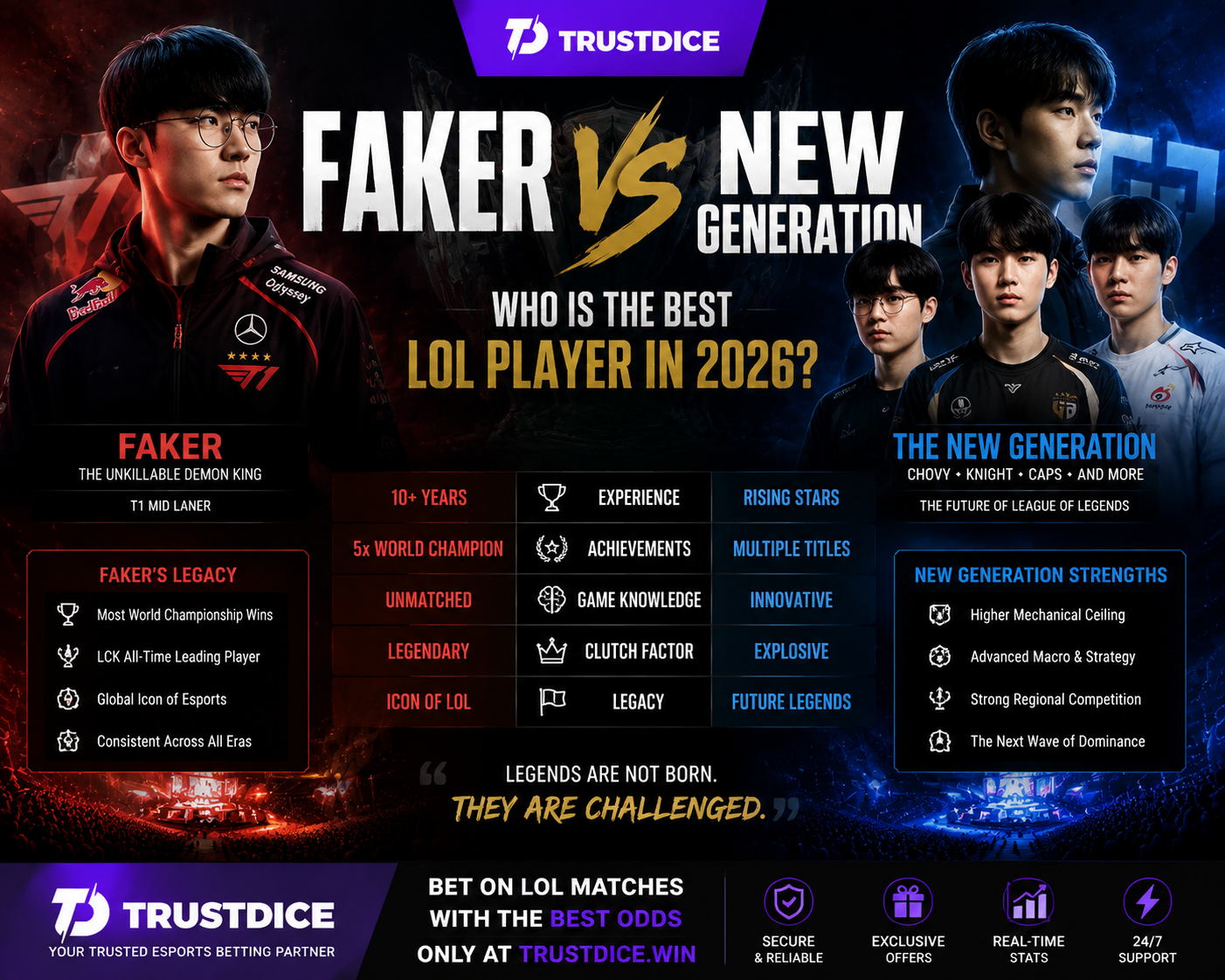
🏆 Faker: The Greatest Legacy in League of Legends History
Faker’s career is unique because very few esports players have maintained elite performance across so many competitive eras. From early mechanical dominance to becoming one of the smartest macro players in the game, his evolution has allowed him to remain relevant as League of Legends continues to change.
His biggest advantage has always been decision-making. While younger players may have faster reactions, Faker’s understanding of timing, positioning, and game flow allows him to influence matches in ways that statistics cannot always measure.
| Category | Faker's Strength | Competitive Impact |
|---|---|---|
| Experience | Years of international competition | Elite pressure management |
| Game Knowledge | Deep understanding of strategy | Better mid-game decisions |
| Leadership | Veteran communication | Improves team coordination |
| Adaptation | Survived multiple metas | Long-term consistency |
🎯 Analyst Insight:
Faker’s greatest weapon is not one mechanical play. It is his ability to understand the entire game better than almost anyone else.
⚔️ The New Generation of LoL Superstars
The current generation of League of Legends players has developed under a much more advanced competitive environment. Young stars enter professional play with stronger training systems, better analytics, and years of watching previous champions.
Players such as Chovy, Knight, Caps, and other elite competitors represent a new style of League. They combine incredible mechanics with aggressive decision-making and modern lane management.
| Player Type | Main Strength | Playing Style |
|---|---|---|
| Mechanical Prodigy | Fast reactions and outplays | High-pressure aggression |
| Strategic Mid Laner | Map control and rotations | Team-focused gameplay |
| Carry Specialist | Damage output | Creates winning conditions |
When analyzing lol bets, comparing individual players requires looking beyond highlight clips. A player’s value depends heavily on champion pool, team system, and ability to perform in different situations.
🔥 Faker vs New Generation: Key Comparison
Mechanical Skill
The modern generation may have a slight advantage in pure mechanical execution. Professional players today begin training earlier and compete in an environment where optimization is extremely advanced.
However, mechanics alone do not decide championships. League of Legends is a strategy game where knowledge and decision-making become more important as competition becomes stronger.
Champion Pool and Adaptability
One of Faker’s biggest strengths has always been his ability to adapt. Throughout his career, he has played control mages, assassins, supportive champions, and unusual picks when needed.
The new generation has also developed impressive champion pools, but maintaining flexibility across multiple years remains one of Faker’s defining achievements.
International Performance
International tournaments create the biggest separation between good players and legendary players. Many stars dominate domestic competition but struggle when facing the world’s strongest opponents.
Faker’s international record remains one of the strongest arguments in the GOAT discussion.
📊 Who Has the Better Competitive Profile?
| Category | Faker | New Generation Stars |
|---|---|---|
| Career Longevity | Exceptional | Still developing |
| Peak Mechanics | Elite | Extremely high |
| International Experience | Historic | Growing |
| Future Potential | Limited by career stage | Very high |
For analysts studying betting on lol, player comparisons should always include context. A superstar on a struggling team may look weaker statistically than a player surrounded by perfect teammates.
⚡ Competitive Insight:
The GOAT debate is not only about who has the highest skill level today. It is about who changed the game and succeeded against multiple generations of competition.
🎮 The Future of League of Legends Greatness
The next few years will determine whether a new player can challenge Faker’s historical position. Winning international championships, maintaining elite performance, and creating a lasting legacy will be the ultimate test.
The new generation has the talent to create their own legendary stories, but replacing a player who has dominated multiple eras requires more than mechanical ability.
For fans exploring lol bets, understanding player mentality, tournament experience, and team dynamics provides a much deeper perspective than simply comparing statistics.
Final Thoughts
Faker versus the new generation is not just a debate about one player against another. It represents two different eras of League of Legends: the era of legendary veterans and the era of highly optimized young talent.
Faker remains the benchmark because of his achievements, intelligence, and consistency. Meanwhile, the new generation continues pushing the limits of mechanical skill and strategic innovation.
Whether you follow esports history, competitive rankings, or betting on lol analysis, one thing is certain: the battle between legends and rising stars will continue shaping League of Legends for years to come.